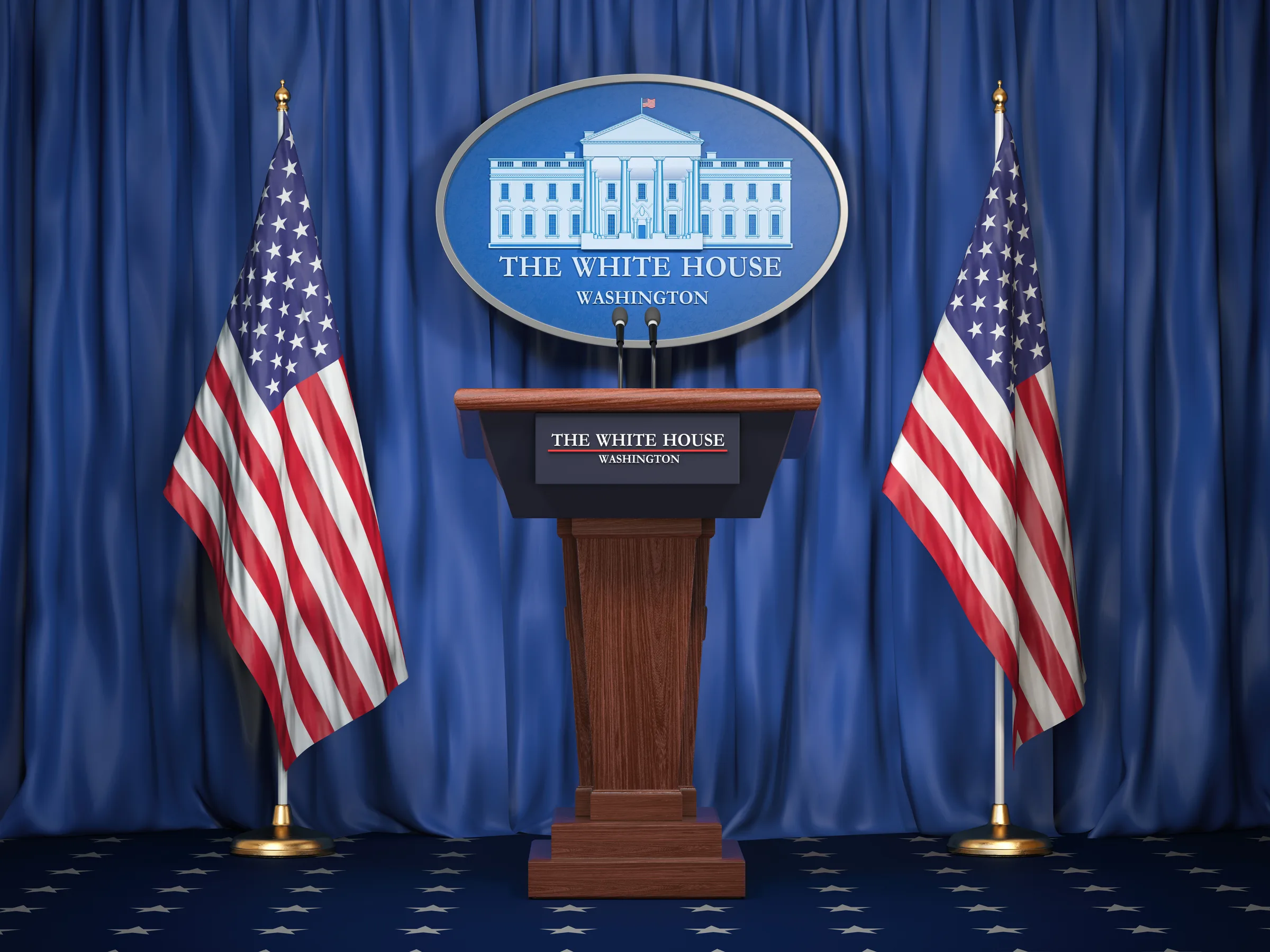
Most of what has been written about the White House press ban this week is about what it means. This piece is about what the documents say. Four of them matter: the complaint the three news organisations filed on Monday, the Justice Department's 19-page opposition filed on Tuesday night, the letter the White House sent CNN that same day to justify the ban after the fact, and the eight-page temporary restraining order Judge Timothy Kelly issued in the early hours of Thursday. All four are attached under this story, taken from the public court docket.1
Six days, in order
Day | What happened |
|---|---|
Fri 18 Sept | Trump announces on Truth Social that CNN, MS NOW and Politico are banned from the White House "effective immediately" for "constant 'reporting' FAKE NEWS". Asked why, he says no single story triggered it: "It's really just cumulative stories over the last few years. You get sick of it." |
Sat 19 | Betsy Klein of CNN, Akayla Gardner of MS NOW and Cheyenne Haslett of Politico are turned away at the gate. The Secret Service takes their hard passes. |
Mon 21 | The outlets file suit in federal court in Washington and ask for an emergency order. The other four networks refuse to replace CNN in the television pool; there is no pool footage of the president. The White House launches "Trump TV" on YouTube. |
Tue 22 | The Justice Department files its opposition, attaching letters to each outlet dated that day. At the UN, Trump tells CNN's Kaitlan Collins: "You should not be here covering me." |
Wed 23 | A hearing by videoconference. Nearly 50 news organisations file a friend-of-the-court brief backing the plaintiffs. |
Thu 24 | Judge Kelly grants a temporary restraining order in the early hours: passes to be restored immediately, for 14 days, hours before Xi Jinping arrives at the White House. |
The timeline is drawn from NPR, CBS News, NBC News and the court docket.257
What the outlets argued
The complaint, brought by Theodore Boutrous of Gibson Dunn, names the President, communications director Steven Cheung, chief of staff Susie Wiles and the Secret Service director as defendants. Its opening line sets the tone: "This ban could not be a more direct assault on the First Amendment nor a more blatant violation of our most fundamental constitutional principles." It makes two kinds of claim. Under the First Amendment, the ban is viewpoint discrimination and retaliation for protected speech. Under the Fifth, the reporters were stripped of a liberty interest, their credentials, without notice or a chance to be heard.710
Its strongest evidence was the President himself. The complaint quotes his Friday remarks, in which he said there was "something wrong with a country that can allow people to write purposefully negative things" and that while they were free to write them, "I don't have to let them into my — into the people's house". In court on Wednesday Mr Boutrous put it more bluntly: "He keeps proving our point. He's literally our lead witness here."29
What the government argued
The Justice Department's opposition, signed by Michael Velchik, begins from a different premise. "Access to the White House is a privilege, not a right," it says, and the President has "compelling reasons" to withhold it: enforcing "minimum standards of professionalism and decorum" and protecting classified information. The filing argues the outlets have been "trafficking in verifiable falsehoods about national security and other issues, and publishing sensitive or classified information".35
The specifics are in the letters, and the letters are worth reading closely because they are the only place the government says which stories it means. The letters to CNN and MS NOW cite reporting on construction of the White House ballroom and East Wing bunker, and on the depletion of American munitions during the Iran war. The letter to Politico objects to its reporting on the lifting of sanctions against Russia and to a story describing the Republican midterm convention in Dallas as "a disaster". All three letters are dated 22 September, four days after the ban took effect, and give the outlets until 5 p.m. on Friday to respond in writing. The government also asked that, whatever the judge decided, the passes not be restored until after this week's visit by China's president.34
Then comes the filing's most striking move. It asks the court to hold that Sherrill v. Knight, the 1977 appeals court decision requiring notice and an explanation before a White House pass is refused, was wrongly decided and should be overruled. Since a district judge cannot overrule the court above him, that argument is not addressed to Judge Kelly at all. It is a marker for the appeal.4
What the judge said
Judge Kelly's order is short and decides the case, for now, on the narrowest ground available: due process. He relies on two D.C. Circuit cases, Sherrill and the 2020 decision in Karem v. Trump, for the rule that a duly issued hard pass may not be suspended without notice and a chance to be heard, and without previously announced standards saying what conduct would cost a reporter their pass. The government, he notes, "do[es] not dispute" that none of that happened here. The one standard it offers, the language in the 22 September letters about "professionalism and decorum", he calls "so vague it hardly does the trick".56
He is also pointed about the timing. Some of the reporting the letters cite was "routine" and months old, and Ms Klein's pass was renewed several months after she published some of it, which the judge says undercuts any claim that she was on notice. On national security, the order says the government offers "little to back up" the interest it asserts: "Nothing in the record that predates this suit suggests that the revocation of Plaintiffs' hard passes was motivated by national security concerns. Certainly, that is not what President Trump said when he announced that he was 'banning' Plaintiffs from the White House—instead, he focused on the alleged lack of truthfulness and negativity of Plaintiffs' reporting."5
What the order does not do is rule on the First Amendment claims. It does not need to. Having found the outlets likely to win on due process alone, the judge restored the passes and left the harder constitutional questions for the preliminary injunction stage. That is a conventional way to write an emergency order, and it makes the ruling harder to attack on appeal, because the appeals court would have to disturb its own precedent to reverse it.
The pool went dark
The most consequential thing that happened this week was not in a courtroom. CNN was due to be the pool camera on Monday, filming the President for every other network. When it was barred, ABC, CBS, NBC and Fox declined to step in. "Effective today, the TV pool will not be covering events designated as pool coverage of the President," the pool chair, Fox News's Bryan Boughton, wrote in a memo. "There will be no replacement pool put in place." NPR, a member of the radio pool, stopped broadcasting the President's audio. The Washington Post, the New York Times and HuffPost said they would not publish images of his New York trip.28
The result was a president cutting the ribbon on a new helipad in a video shot by his own staff, in which the helicopter behind him drowned out whatever he was saying. The White House's answer was a YouTube channel, "Trump TV: The Essentials Station", offering past press conferences with better sound. Secretary of State Marco Rubio defended the ban on NBC's Today: "We're not closing CNN. They're just not allowed to work from the workspace at the White House." The friend-of-the-court brief from nearly 50 news organisations, including CBS, called the government's reasons "transparently viewpoint discriminatory" and warned that "the President has indicated that evictions of other news organizations will follow".485
What happens next
Three things. First, the 14-day order expires, and the judge must decide whether to convert it into a preliminary injunction, which would require him to reach the First Amendment questions. Second, an appeal. Trump wrote on Monday that "almost without question and, as usual, we'll go for appeal", and the Justice Department's request to overrule Sherrill only makes sense as a case built for the D.C. Circuit and, potentially, the Supreme Court. Third, the Associated Press. Its own suit over being barred for declining to say "Gulf of America" is still working through the courts, and whichever case gets to the appeals court first will shape the other.43
Judge Kelly was the judge who restored Jim Acosta's pass in 2018, a fact Trump noted himself before the ruling. The White House then chose to give Acosta his pass back rather than appeal. This time it has said the opposite, and the argument it has chosen, that a fifty-year-old precedent should go, suggests it means it. Read the documents. The next round will be argued from them.4

Comments
Sign in to join the conversation.