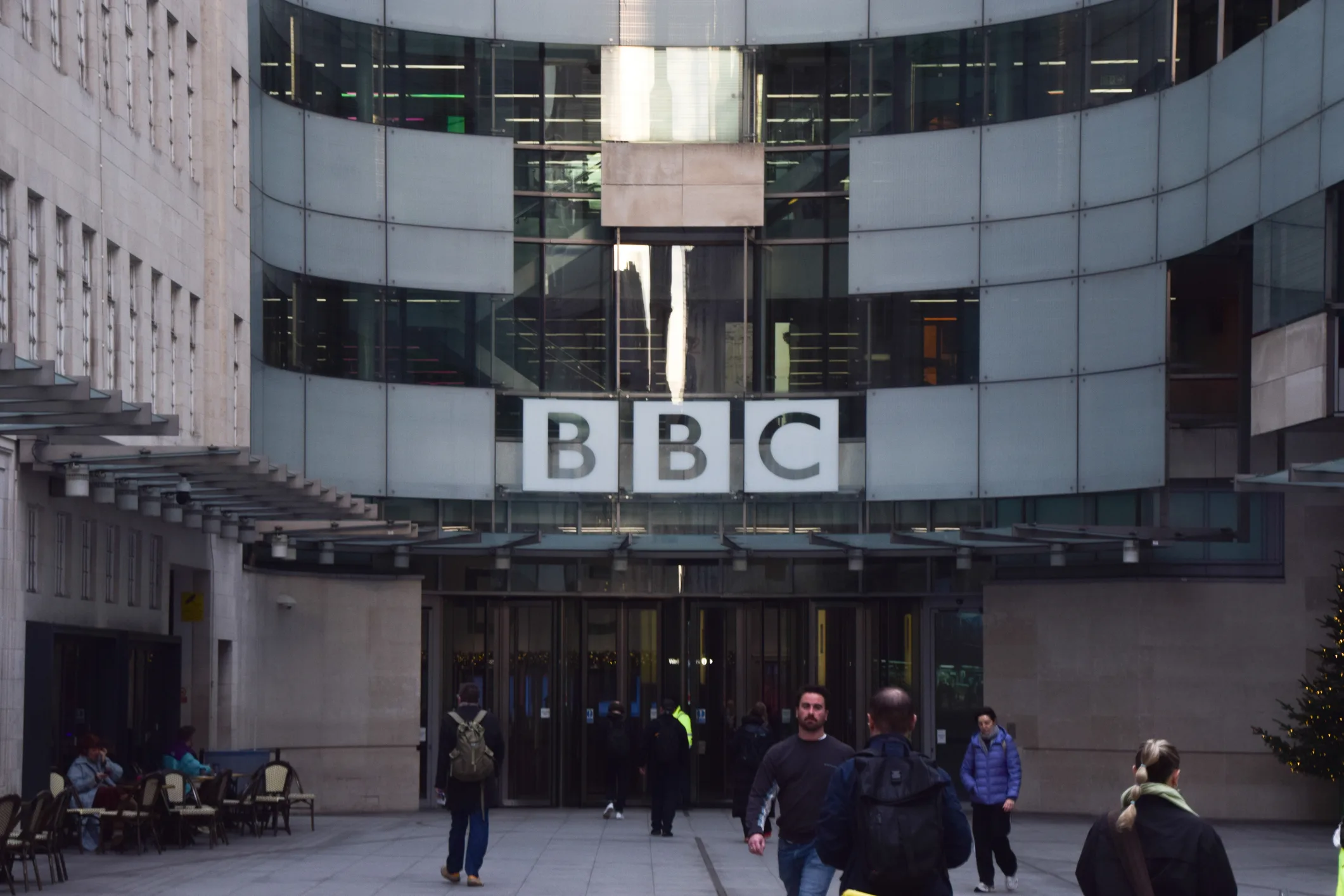
There is a well-worn way to argue about BBC bias. One side produces a clip, the other produces a different clip, and everyone goes home confirmed. This piece does something narrower and, we think, more useful. It does not look at what the BBC broadcasts. It looks at what the people who write its news say when they are speaking for themselves, on their own social media accounts, over years. If BBC journalists are a left-leaning group, their own words are where it should show.
The result is not the clean answer either camp wants. Most of them show nothing at all. A minority do, and that minority tilts left; on this sample nobody codes right. The tilt is real, modest in absolute numbers, and mostly older than their BBC careers. The people who write the political coverage are the cleanest of the lot.
How we did it
Nobody was chosen by name. On the morning of 25 September 2026 we took 24 stories from the BBC News UK homepage and recorded every named byline: 19 journalists. The next day we did the same for 14 section pages, from politics and business to the four nations, science, climate and the US. That gave 141 more names. We split them into a first tier of 50 politics, UK affairs and specialist correspondents, and set out to find and read their public social media. This article covers the 19 from the homepage and the 40 first-tier names we were able to collect before publication.1
Accounts were found from colleagues' mentions, Wikipedia and Wikidata, Bluesky bios that identify the person as BBC staff, and a search of X by name. For each account we saved the Posts tab and the Replies tab of X, and where the person has a Bluesky account we downloaded the whole public feed through Bluesky's open interface. X does not show unlimited history, so for some accounts we could see years and for others only months. That is stated per person in the appendix. Reposts on X were not captured, so what people amplify is assessed only for the 20 who use Bluesky.
The coding rules were written down before the second round of data was collected, and they are attached in full. In short: only the person's own words count. Quotes of politicians, live-reporting threads, headlines of their own stories and links to their own reporting are excluded. A post counts as showing a stance only if it takes a side on one of ten contested issues: immigration, Brexit, tax and welfare, trans rights and sex-based rights, climate, Israel and Gaza, race and policing, the monarchy, Trump, and the culture war. A single post gives a lean. Two issues the same way, or one issue repeated over time, gives a clear stance. Both directions gives mixed. Posts from before the person joined the BBC count, because a view does not vanish on signing a contract, but they are reported separately. We also checked all 19 round-one names against the Electoral Commission's register of donations. None appears.7
Two limits should be said up front. First, the reading was done by an AI assistant, in the first edition through keyword filters and then the flagged posts in full, and in this edition by reading all 16,988 posts and replies in date order, with a human editor checking the coded posts and the categories. The rubric asks for an independent second coder and we did not have one. Second, we did not collect a control group from Sky News or ITV News, so the comparison offered below is with the profession as a whole, from an older survey. Both gaps are the next step, not a reason to withhold what we found.
What we found
Of the 59 journalists identified, two have no public account we could find. Of the 57 we read, 41 show no political stance of any kind. That is not because they are silent. Laura Kuenssberg's account gave us 1,404 posts and replies, Lindsey Alder's 1,500, Bernd Debusmann's 280, almost all of them about Donald Trump, whom he covers daily from the White House without once telling you what he thinks of him. Sixteen people show something.
Group | Read | Show a stance | Left | Right | Mixed |
|---|---|---|---|---|---|
Political reporters, Westminster and the nations | 18 | 2 | 1 (pre-BBC) | 0 | 1 |
Home, business, world and specialist desks | 39 | 14 | 11 | 0 | 3 |
All | 57 | 16 | 12 | 0 | 4 |
The five clear cases are Jessica Rawnsley, Oscar Edwards, Luke Mintz, Hayley Clarke and Dominic Casciani. Rawnsley, a home news reporter, spent 2019 to 2021 as a freelance writing for the Guardian, the Economist and the FT, and her account from those years is unambiguous: Extinction Rebellion critics are running a distraction and "we need millions of these 'hypocrites'"; a Conservative election video is "a bizarre election tactic"; the government "refuses to release" a fracking report; a debate on "whether capitalism should end or be regulated" was "thoroughly persuasive"; the Goldsmiths strikes showed universities becoming "profit-making machines". Edwards, before the BBC, thanked a Labour ward for backing a pub workers' strike, attacked the Express under the hashtag #rightwingmedia and signed off a summer of Black Lives Matter marches in Brighton with "This movement is not over. On to 2021." Mintz, at the Telegraph before the BBC, called Section 28 "that monstrous policy", found nothing more infuriating than "Tory ministers pretending to care about anti-Semitism in Labour then being totally cool with racism in their own party", and wrote that once the pandemic was over "asset-rich pensioners should do their bit". Hayley Clarke, then a radio producer, wished to "get back in the Tardis and spin us back to pre Brexit", asked "What kind of person do you have to be to boo people taking a knee?", and described the prime minister at Christmas 2020 as "stuffing his face full of turkey in his giant house". Casciani, the BBC's home and legal correspondent, is a different kind of case: his coded posts are about the rule of law, the Retained EU Law bill, jury trial, and the limits of terrorism law, and he left X for Bluesky calling it "the other hate-filled place". We have coded that liberal-institutional rather than partisan, and readers can decide whether that is a political stance or a lawyer's temperament.891011182228
The seven leans to the left are thinner. Adam Goldsmith, now a political reporter, posted as a student in June 2020 that "racism isn't just something that happens in America" and recommended a Dave album as "a necessity". Tom Espiner, at a technology trade site in 2011 and 2012, called the licence fee freeze "an absolute travesty" and retweeted a claim about Tory peers' interests in NHS reform with the words "Rotten boroughs indeed". Harry Sekulich, at ABC News in Australia in 2023, wrote that "the rise of anti-LGBTQ extremism should disturb everyone". Katy Watson, the BBC's correspondent in Australia and before that South America, wrote in October 2022 that Lula was "taking back the flag" from Brazil's far right, and has campaigned on the rules that keep disabled migrants out of Australia, rules that she has disclosed caught her own family. Sanchia Berg, who left the BBC staff in 2025 and now freelances for it, called a rebuttal of Trump's attacks on NATO "a welcome counter". Egon Cossou, a business journalist, shared "savage" anti-Trump comedy in 2015 and 2016. Esme Stallard, the climate reporter, is the judgement call of the set: she called HSBC's decision to stop financing new oil and gas fields "positive (for most people)" and the UK's exit from the Energy Charter Treaty "important" for net zero policy. The first edition treated that as enthusiasm for her beat. Read in full, they are own-voice approvals on one of the rubric's ten issues, so she is coded a lean; readers who think a climate reporter welcoming climate policy is not a party position can subtract one.16171920212930
On the right there is nobody, and that is the largest change from the first edition, which had two. Lindsey Alder, then a news editor at LBC, wrote in September 2024 that "the British economy would be in much better shape if the Mini Budget had been implemented". That remains the only unambiguous right-wing economic statement in 17,000 posts. But her 2022 posts, which the filters had not surfaced, run the other way: "LETTUCE REJOICE" on the day Liz Truss resigned, "#ByeBoris", "Everyone involved should be deeply ashamed" of the energy price cap, and "Terrifying" for a Republican congresswoman's "white life" remark. The rubric says both directions is mixed, so she is mixed. Dan Sales, before the BBC, spent four years at MailOnline producing a stream of stories about "woke" firms, "bonus holes" and trans prisoners, and in his own voice asked of Scotland's decision to house a transgender rapist in a women's prison, "How can anyone think something like this is okay?" Against that, his own-voice comments on the government of the day are consistently hostile: Liz Truss's anti-growth coalition was "pathetic", Boris Johnson's Sue Gray press conference "an absolute car crash", the 45p tax U-turn "a stroppy, petulant and ill-gracious capitulation", the spring statement a gift to "elderly Tory voters". The first edition coded him right by output and said a stricter reader would call him mixed. The stricter reader was right.1314
Four are mixed: Alder and Sales, and two others. Harry Farley, a political correspondent, wrote in the Independent on Christmas Day 2015 that "as someone who used to work for a Tory MP I feel thoroughly disillusioned with how the poor are dismissed as feckless beggars", an argument from Christian conscience rather than from the left. Michael Dempsey, a freelance business contributor, is a self-described Remainer who told fellow Remainers their "open contempt" for Leave voters was inexcusable, mocked Jeremy Corbyn's "heroic battle against, er, privilege", praised a country where "our constitutional monarchy gets the respect it's due", called "the whole Greta circus very disturbing", lamented "the destruction of grammar schools" and found a "complete absence of any true human empathy in the revolutionary left". Under the rubric one Remain statement against five conservative ones is still mixed. On the weight of the posts he is the most right-leaning person in the sample, and he is a freelance, not staff.61215
The politics desk
If the BBC's political coverage were written by people with a settled ideological lean, this is where it would show. It does not. Eighteen of the 57 are political reporters: the Westminster lobby, the political editors and correspondents for Scotland, Wales and Northern Ireland, and the Berlin and South America correspondents who came through Westminster. Sixteen show nothing. One, Goldsmith, has the student post above. One, Farley, is mixed. Nobody on the politics desk has a coded post from their time at the BBC. The full read did not change a single coding on this desk.
More than that, several of them spend a noticeable share of their replies fending off bias accusations from both flanks. Iain Watson, accused of endorsing the government's line on "foreign courts", replied: "Nonsense. I said nothing about 'foreign courts'. I used a clip of the PM using that phrase followed by Keir Starmer pledging not to break international conventions. Reporting accurately what the PM said, with an opposing view, cannot be seen as endorsement by any reasonable person." To a critic from the other direction he wrote: "It's neither lazy nor lying. Don't invent an agenda on my behalf."24
Matt Chorley, who presents on 5 Live and Newsnight, is accused in his replies of favouring Tory guests and of attacking the Tories, of over-covering Nigel Farage's finances and of ignoring them. His answers are consistent: "Some people like Tory voices, some don't. We have a responsibility to provide a range of voices." And, to a listener who thought a quarter of Labour MPs calling for the prime minister to go was not news: "I can't help you." The one genuinely controversial moment in his feed is his own. On 3 June 2026 he apologised to Farage for saying "white cold rage" on Newsnight when Farage had said "pure, cold rage", calling it "a mistake on my part".25
Joe Pike's feed is a useful corrective to the idea that BBC political reporting only points one way. In the period we read he broke the Farage classmates' racism story and the questions about Farage's £5m gift, but also the Labour honeytrap arrests, Len McCluskey's hotel and private jets, a Labour candidate's "worst tan possible for a black man" remark and a Labour MP's mouldy rental flats, and he called the BBC's undercover investigation into legal advisers coaching asylum seekers to pose as gay "important" and a "must-read". Ione Wells, signing off from South America, described her approach as trying "to always humanise the people at the heart of big global stories: impartially and non-judgementally". Pallab Ghosh, the science correspondent, put it more bluntly when he joined Bluesky: "I don't do partisan politics because of the Beeb's impartiality rules."232627
What does not count, and why
Most of what a political reporter posts looks partisan if you squint, because it is about parties. Henry Zeffman writing that Labour people keep telling him "Dominic Cummings was right" about Whitehall, or that Robert Jenrick's defection is "a massive moment for the future of the British right", is analysis of other people's politics, not a statement of his own. Laura Kuenssberg's 1,400 posts and replies are almost entirely trails for her programme and quotes from guests. David Deans describing a "left-bloc of sorts" that might keep Reform out of the Welsh government is describing the arithmetic. The rubric excludes all of it, and it has to, or every lobby correspondent would be coded as whatever party they last quoted.
The line is whether the person takes a side on a contested issue in their own voice. Rawnsley calling XR critics a distraction is her own voice. Casciani asking Chris Philp whether he supports "the ancient right to trial by jury" is his own voice. Glenn Campbell saying of climate protesters at Holyrood, "I just don't see how their tactics advance their agenda", is his own voice too, and it points the other way from Rawnsley, but a single mild remark about tactics is below the rubric's threshold and he is coded none. Esme Stallard calling the Conservative government's £2 bus fare cap "brilliant news" is enthusiasm for her beat, not a party position; her posts welcoming an oil and gas financing ban are the borderline, and we have put them just over it. Dearbail Jordan enjoying a satirical book about the 2022 Conservative governments, "laughing a lot but also want to scream", is quoted in the appendix and not coded, because disliking the government of the day is not one of the ten issues. Where a post could be read either way we coded it as reporting. That choice keeps the count small. It also means the 16 who were coded are the ones where there was no honest way to avoid it.
The nations and the specialists
The Scottish, Welsh and Northern Irish political correspondents are, if anything, more careful than Westminster. Glenn Campbell's account covers the SNP's finance investigation, the Sturgeon resignation and the gender reform bill in three years of posts without one that takes a side; his most opinionated line is that a fourth suspension of a Holyrood sitting was "ridiculous". Jayne McCormack reports Stormont and runs 10Ks. David Deans, Cemlyn Davies and Gwenno Robinson cover the Senedd, in Welsh and English, and show nothing. Gareth Lewis's most political remark is asking listeners what they would like Liz Truss to do first.
Among the specialists, the two whose beats most invite opinion are the ones who most conspicuously withhold it. Bernd Debusmann files from the White House press pool, quotes Trump verbatim several times a day, and in 280 posts never characterises him. Laura Bicker, in Beijing, analyses the tariff war in terms of who it hurts, which includes "Trump's base", and leaves it there. The business desk is the one place we found people who sound like ordinary citizens with views: Dempsey's Remainer-who-respects-Leavers, Cossou's Trump comedy, Espiner's 2012 retweet, Katy Austin's rail strikes covered as timetables and nothing more. Katy Watson is the specialist with the clearest record, and it is worth being precise about it: one approving line about Lula in 2022, a long and open campaign about how society treats people with Down's syndrome, and reporting on Australia's rules for disabled migrants while, as she disclosed, her own family was caught by them. The first is a lean. The second is not on anyone's list of partisan issues. The third is a conflict-of-interest question, disclosed, rather than a bias one.
Before and after the BBC
The BBC tightened its social media rules in October 2020, telling news staff not to express personal opinions on politics or controversial subjects. The guidance is still in force. Whatever else one concludes, our reading suggests it works: the people who have the strongest coded stances earned them before they arrived.3
When the coded posts were made | Left or liberal | Right | Mixed |
|---|---|---|---|
Before joining the BBC | Rawnsley, Edwards, Mintz, Hayley Clarke, Goldsmith, Espiner, Sekulich | none | Alder, Sales, Farley (2015 op-ed) |
While working for the BBC, staff or freelance | Casciani, Katy Watson, Berg, Cossou, Stallard | none | Dempsey, Farley (faith reporting) |
Nine of the 16 coded stances, including both of the first edition's right-leaning ones and three of the five clear left cases, rest entirely on posts from before the person joined. Counting only what people wrote while working for the BBC, the tally is five left or liberal, two mixed and none right. That is a smaller number, but it is also a lopsided one, and it is fair to say so.
Three things temper it. Two of the five BBC-era left codings are old or weak: Cossou's are comedy shares from a decade ago, and Berg's is support for NATO against Trump, a position held by every party leader in Britain. Stallard's is the judgement call described above. And Casciani's coding is, as noted, a judgement call about whether defending jury trial and the Human Rights Act framework is a political position or a legal correspondent's job.
Compared with what?
The obvious objection to any count like this is that journalists in general lean left, so a left tilt among BBC staff tells you about the trade, not the corporation. The objection is well founded. The last large survey of the profession, run by the Reuters Institute in December 2015 with 603 journalists answering the politics question, found 53% placing themselves left of centre, 24% at the centre and 23% to the right. Right-of-centre views increased with seniority. On those figures, the profession runs about two and a third to one, left to right, among those who take a side.2
Our figure for the BBC sample is twelve left to none right among those who show a direction, with four mixed. That is not a ratio; it is a shutout, on a sample of 16. It is plainly higher than the profession's self-description, but the two numbers are not measuring the same thing. The survey asked people to place themselves; we inferred a position from what a minority chose to post. Most of our 57 would presumably have placed themselves somewhere on the survey's scale while showing us nothing at all, and the four we call mixed would sit near its centre. The honest statement is that the BBC sample looks more left-tilted than the profession's self-description, on evidence too thin to say by how much.
There is a way to settle it, and we have committed to it in writing. The editor's hypothesis, recorded in the attached method note before any further data was collected, is that a four-to-one ratio will hold as the sample grows. The full read has already moved the starting point, from nine to two to twelve to nought, before a single new person was added; the prediction stays on the record as written, to be judged against the corrected baseline. The test is to extend the reading to the rest of the first tier and to the 91 second-tier bylines, and to collect the Sky News and ITV News politics teams the same way as a control. If the BBC count stays lopsided and the control group comes out even, that is a finding about the BBC. If both come out the same, it is a finding about journalism. Either way the method is the same and the rubric does not move.
What the BBC's own reviews already said
None of this is the first attempt to ask whether the BBC's people lean one way. The Serota review of 2021 found a culture problem in editorial standards and impartiality rather than a partisan one, and the corporation's thematic reviews of its coverage of tax and spending, and of migration, found framing errors in both directions rather than a consistent tilt. We went through those studies, and the political histories of the presenters and executives, in an earlier piece and will not repeat them here. The point of this one is different. Content studies measure the output. This measures the people, in their own words, and finds that the great majority keep them to themselves.45
What this cannot tell you
It cannot tell you what anyone privately believes. Silence on X is not neutrality; it is compliance with a rule, or temperament, or good sense. It cannot tell you what a newsroom does with 41 people who say nothing and 16 who say something. It cannot tell you whether the tilt among the 16 is unusual, because the control group is not yet collected. It can only see what X chose to show us, which for some accounts was months rather than years, and it did not capture what people repost on X. It relied on one coder, machine-assisted and human-checked, and the rubric asks for two; the first edition's filters missed posts that a full read found, which is why this edition exists. And it counts 57 people out of a news division of several thousand.
What it can tell you is limited but firm. Taken from the bylines the BBC itself chose to put in front of readers in one week, the journalists who reveal a political view are a minority; that minority leans left, and on this sample nobody leans right; the lean lives mostly in careers before the BBC and in desks other than politics; and the political reporters, the ones whose judgement shapes what the country hears about its government, show nothing at all. Every quoted post is in the appendix with its date, so the coding can be checked and disputed by anyone who cares to.

1 comment
Sign in to join the conversation.
The most interesting part for me is actually the limitation the piece acknowledges: without a control group from outlets like Sky or ITV, it’s difficult to separate a BBC-specific pattern from a broader pattern within journalism. I also think the distinction between views expressed before joining the BBC and those expressed while working there adds useful context. The 41 journalists who showed no political stance at all are just as interesting as the 16 who did, especially given how cautious the methodology is about what counts as an actual political position.