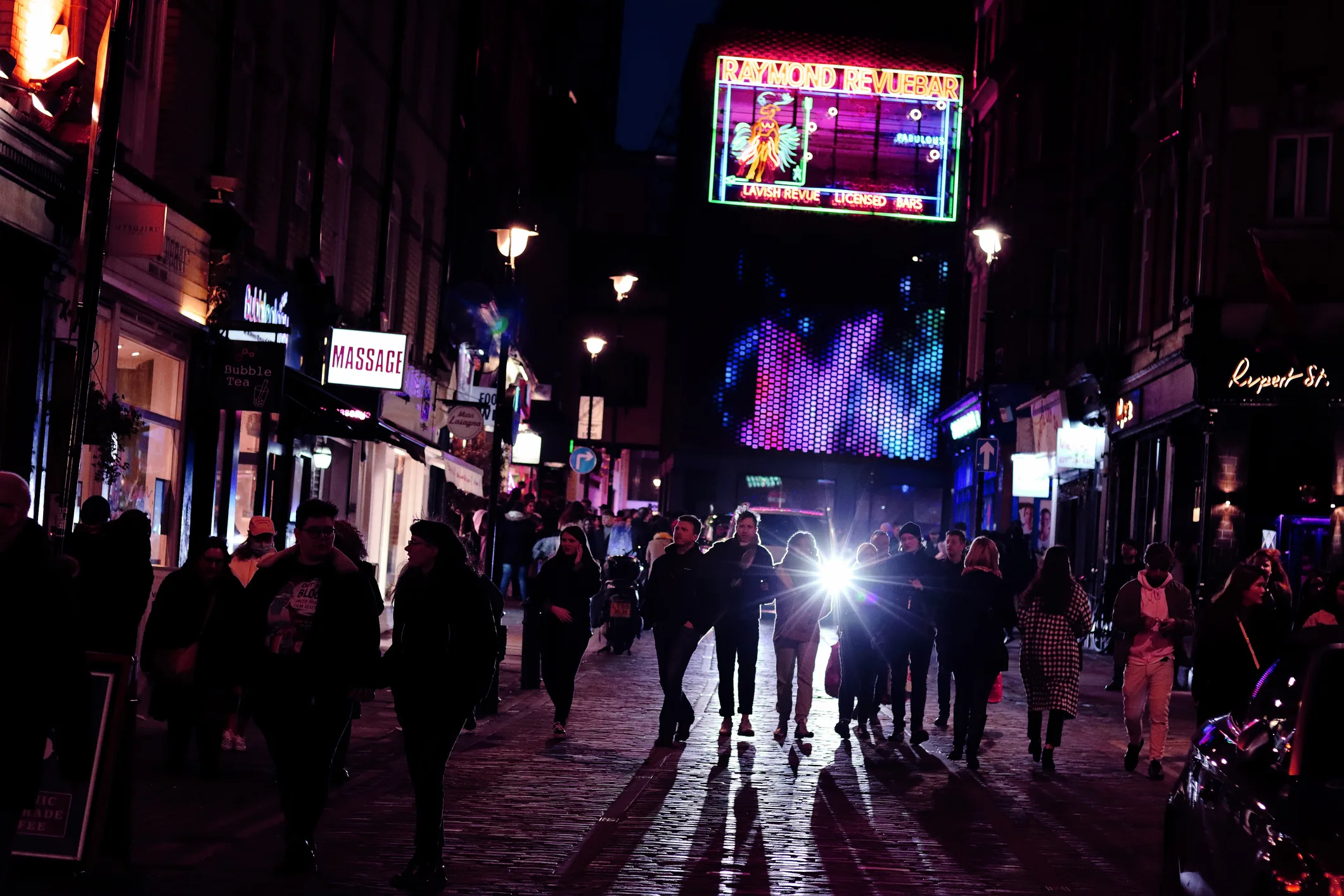
The story of London's nightlife, as it is told across a pub table, goes something like this. The Mayor has made it impossible to run a bar or a club. You need a licence to let people dance. If the police are called, the council shuts you for six months. And now they want to ban standing up with a drink. Almost none of that is true, and the parts that are true are not the Mayor's doing. But the anxiety behind the story is well founded. London is losing its late-night venues, faster than most of the country, and the rules that decide which survive are more fragmented, and in places stricter, than in any other British city. This piece is about what the numbers say, who actually holds the pen, and why it matters to more people than the ones who go clubbing.
How many have gone
The best running count of Britain's late-night venues is kept by the Night Time Industries Association with the market researcher NIQ, using its outlet database. Its latest bulletin, published on 21 September 2026, says that 28.7% of Britain's late-night venues have disappeared since March 2020, which it equates to an average of 12 net closures every month. Nightclubs have been hit hardest, down 36.1%, about six net closures a month. Late-night bars are down 23.9%. The whole of hospitality is down 14.4% over the same period, so the after-midnight trade has shrunk at twice the rate of the sector around it. There was a flicker of good news in the same release: late-night venue numbers rose 0.4% between March and June 2026, the first quarterly rise in a while. But the year-on-year figure is still a fall of 3.1%, and only 48% of the late-night venues that existed before Covid are still trading unchanged today; 38% have gone and 14% are new entrants.12
London does worse than the average on every cut of these figures. The August 2025 monitor put Greater London's late-night venue count at 343, down from 433 in March 2020, a fall of 20.8%, and the London region's night-time economy as a whole down 15.3%, the second-worst region after Wales. The September 2026 bulletin gives Greater London's night-time economy as 15.5% below its pre-pandemic level against a British average of 14.3%, while Newcastle and Liverpool are only 5.5% below and the North East region 10.5%. An earlier NTIA count, reported by the BBC in April 2024, said 3,011 night-time businesses had closed in London and its surrounding boroughs between March 2020 and December 2023, 1,165 of them in London itself, the steepest fall of any English region.1246
Two honest qualifications. First, the picture inside the capital is uneven. The NTIA's February 2026 bulletin recorded late-night venue growth of 2.7% in central London during 2025 even as the national count fell 4.1%, and its January 2025 nightclub census, which found the number of British nightclubs had dropped from 1,240 in March 2020 to 835 in November 2024, noted that London and the North East had shown small increases in 2024. The losses are heaviest in outer boroughs and in the suburbs and towns around London, and heaviest of all in independent venues. Second, these are trade-body figures compiled from a commercial database, not official statistics. They are consistent quarter to quarter and are the numbers government and City Hall themselves quote, but they are not audited.35
What the official statistics show is subtler and, in a way, more telling. The Home Office counts premises licences, the permission that lets any premises sell alcohol, whether it is a supermarket, a hotel bar or a basement club. That count has never been higher. There were 224,100 premises licences in England and Wales at 31 March 2024, up from 195,800 in 2007/08, and London, with 34,590, had more than any other region. Licences to sell alcohol are not disappearing. The places that stay open after midnight are. The next Home Office release, covering the year to March 2026, is due on 1 October 2026 and will be the first official data since 2024.7
Beyond bars and clubs, the London Assembly's economy committee collected the longer series in February 2025. Grassroots music venues in London fell by 35%, from 144 to 94, between 2007 and 2016, then recovered on the GLA's count to 132 by 2022. LGBTQ+ venues fell from 121 in 2006 to 51 in 2017 and have held at about 50 since. The committee's summary of what venues told it about licensing is blunt: it has been "described as disjointed by some businesses, many of which find London's licensing landscape difficult to navigate", licensing authorities "have a limited understanding of the value that the night-time economy provides", and practice "focuses almost exclusively on the prevention of anti-social behaviour and crime, as opposed to promoting the growth of the night-time economy". And the structural line under it all: "As a result of every borough being responsible for its own licensing regime, there currently is no pan-London approach to licensing."9
Who actually decides
The Mayor of London does not license anything. Under the Licensing Act 2003 the licensing authority is the borough council, 33 of them in Greater London including the City, and each must publish its own statement of licensing policy every five years. The Metropolitan Police is a "responsible authority" that can object to any application and can trigger a review. Residents can object. The Mayor, until this year, could only lobby. That is not a technicality; it is the reason a venue on one side of a borough boundary can be told its last entry is 11pm while one across the road trades to 2am. The Nightlife Taskforce that the Mayor set up, chaired by the co-founder of Fabric, surveyed operators and found that 52.5% of nightlife space operators described London's licensing process as "overly complex, lengthy and expensive", and 64.2% of promoters reported difficulties with temporary event notices. Operators cited "disparities between different boroughs' late-night policies, caps on the number of TENs allowed in a given area, and restrictions on opening hours as particular problems". One Hackney venue told the Taskforce it had faced £117,000 in costs and £350,000 in lost income from last-minute objections by a neighbouring business.10
There is no separate licence for dancing. Where music and dancing still need permission at all, they are covered by the same premises licence that covers the bar, as "regulated entertainment", and the council can attach conditions to it. What people remember as a dancing licence is the pre-2005 public entertainment licence, or the conditions councils now write into premises licences about hours, capacity, door staff and, in Westminster's case, seating. Those conditions are where the real fight is.
The 48-hour rule, and what Fabric shows
The belief that a venue is shut for six months if the police are called comes from a real power, misremembered. Since 2007 a chief officer of police can apply for a summary review of any licence to sell alcohol, provided a superintendent or above certifies that the premises are "associated with serious crime or serious disorder or both". The council must then, within 48 hours, decide whether to take interim steps, and it may do so "without the holder of the premises licence having been given an opportunity to make representations". The interim steps include suspending the licence, and the suspension takes effect immediately. The owner can demand a hearing, which must be held within 48 hours of their objection. The council must then hold a full review within 28 days. At that review the strongest outcomes available are suspension "for a period not exceeding three months" or revocation. Separately, since 2014 a police inspector or the council can issue a closure notice for nuisance or disorder, and a magistrates' court can make a closure order, again for a period "not exceeding 3 months". So there is no six-month shutdown. What there is, is a mechanism that can close a venue tonight on one officer's certificate, keep it closed for up to a month before anyone has fully heard the case, and end its licence altogether.1112
Fabric is the case everyone cites, and it repays a close look because it shows both edges of the power. Two 18-year-olds died after taking drugs at the Farringdon club in June and August 2016. A 28-day suspension followed the second death, and on 7 September 2016 Islington Council's licensing sub-committee, after more than five hours of evidence, revoked the licence, finding that searches at the venue had been inadequate and describing a "culture of drugs". The Metropolitan Police had argued that keeping Fabric open would cause further drug-related deaths. Then, on 21 November 2016, a district judge at Highbury Corner approved an agreement between the club, the police and the council under which it reopened with covert surveillance inside, ID scanning at the door, lifetime bans for anyone caught with drugs, and no under-19s from Friday evening to Monday morning. More than £320,000 had been raised for the appeal. The council that revoked the licence and the police that sought the revocation both signed the deal that reversed it. It is a story about a regime that can end a business in a night, and also about one that can be negotiated with.2324
The scale of that regime is smaller than the folklore suggests. In the year to March 2024 there were 412 licence reviews of any kind in England and Wales, of which 163 ended in revocation and 49 in suspension. London's boroughs completed 72 of those reviews, 32 of them ending in revocation, on more than 34,000 licences. The number of reviews in London has fallen, not risen: 172 in 2017/18, 88 in 2021/22, 72 in 2023/24. Per thousand premises licences, London's boroughs completed 2.1 reviews in 2023/24. Manchester completed 3.7, Birmingham and Leeds 5.7 each. If you measure enforcement by how often councils drag a licence in front of a committee, London is not the strictest city in England. It is about average.7
Where London is tight: the front door
The strictness is at the point of entry. A cumulative impact area, or zone, or special policy area, depending on the borough, is a district where the council has decided that there are already enough licensed premises and that any new licence, or any extension of hours, will be refused if anyone objects, unless the applicant can prove it will add nothing to the problem. At 31 March 2024 there were 182 of them in England and Wales, in 75 councils. Seventy of the 182 were in London, spread across 20 boroughs, on 15% of the country's licences. Brent alone had 12, the most of any authority in the country; Greenwich had seven, Islington six, Croydon, Ealing and Newham five each. Manchester, Birmingham and Liverpool had none. Leeds had six and Newcastle nine. London's boroughs also ran six of the nine late-night levies in England and Wales, the charge on premises trading after midnight: Camden, the City, Hackney, Islington, Southwark and Tower Hamlets raised about £2.1m of the £2.6m collected nationally.7
Licensing authority, 2023/24 | Premises licences | 24-hour licences | Cumulative impact areas | Reviews completed | Revoked | Late-night levy |
|---|---|---|---|---|---|---|
Westminster | 4,137 | 88 | 1 | 3 | 2 | No |
Camden | 2,040 | 74 | 2 | 4 | 2 | Yes, £297,000 |
Hackney | 1,592 | 35 | 2 | 0 | 0 | Yes, £450,407 |
Islington | 1,472 | 58 | 6 | 0 | 0 | Yes, £459,000 |
Southwark | 1,537 | 377 | 3 | 3 | 1 | Yes, £354,157 |
Tower Hamlets | 1,272 | 72 | 2 | 1 | 0 | Yes, £312,000 |
All 33 London boroughs | 34,586 | 1,554 | 70 | 72 | 32 | 6 boroughs, £2.1m |
Manchester | 2,725 | 105 | 0 | 10 | 5 | No |
Birmingham | 3,508 | 258 | 0 | 20 | 6 | No |
Liverpool | 2,725 | 193 | 0 | 4 | 3 | Yes, £252,000 |
Leeds | 2,444 | 99 | 6 | 14 | 8 | No |
Bristol | 2,025 | 74 | 1 | 4 | 4 | No |
Newcastle upon Tyne | 1,330 | 62 | 9 | 1 | 0 | Yes, £209,136 |
The table is from each council's own return to the Home Office; Lambeth made no return that year and is missing from the London total, and the full borough-by-borough figures for three years are in the attached appendix. Two things stand out. Liverpool has 193 premises licensed for 24 hours, 104 of them pubs, bars or clubs, against one such venue in Westminster. And the six inner London boroughs that contain most of the capital's nightlife completed 11 reviews between them in a year, while running 16 cumulative impact areas and five levies. The tools London uses are the ones that stop things opening and stop them staying open late, not the ones that shut them down.
The second tool is hours. Every inner London policy carries a set of "core" or "framework" hours, a presumption about when a bar or club should close, beyond which the applicant has to justify itself and, in a cumulative impact area, will usually be refused. They are earlier than most people assume.17202122
Borough policy | Pubs and bars, Monday to Thursday | Pubs and bars, Friday and Saturday | Nightclubs | Cumulative impact policy |
|---|---|---|---|---|
Westminster (2021) | 11.30pm | Midnight | Same as pubs (music and dance venues) | West End zone; policy is to refuse new pubs, bars and clubs |
Hackney (2023 to 2028) | 11pm | Midnight | Not separately stated | Special policy areas, "strictly applied" |
Islington (2023 to 2027) | 11pm | Midnight | 1am Sunday to Thursday, 2am Friday and Saturday | Six areas since 2013, including Clerkenwell, Bunhill, King's Cross, Angel |
Camden (2025 to 2030) | Midnight | 12.30am | Not separately stated | None designated; decided case by case |
Tower Hamlets (2023 to 2028) | 11.30pm | Midnight | Not separately stated | Brick Lane area, retained and expanded 2024 |
Westminster's policy is the one that matters most, because the council licenses more than 4,000 premises, more than any other authority in Britain. Its 2021 statement says the council "wishes to discourage drunkenness and to encourage the provision of more seating in premises which serve alcohol for people to sit and enjoy a drink and order food by table service, in place of open bar space which caters for high volume vertical drinking", and that its policies "are intended to encourage change in the composition of Westminster's evening and night-time economy so that it becomes more widely based and less dominated by alcohol led premises". In the West End cumulative impact zone, the stated policy is "to refuse" new pubs, bars and music and dance venues, with exceptions only for applications that stay within core hours or reduce capacity. Among the measures the policy says can help an applicant is "introducing fixed seating and conditions to provide a minimum number of seats at all times and limiting sales to be by waiter or waitress service only". Islington's policy says the same in fewer words: among applications it wants to encourage in its impact areas are premises "with robust arrangements to prevent vertical drinking, for example fully seated venues".171921
The vertical drinking row
So when Westminster published a draft of its 2026 policy in August and the phrase "vertical drinking" went round the country, the language was not new. It had been in force since 2021 and, in adjacent form, for years before that. What was new was the audience. The draft, as the BBC reported it, said the council would "discourage excessive drunkenness and encourage the provision of more seating in premises that serve alcohol for people to sit and enjoy a drink and order food by table service in place of open bar space that caters for high volume vertical drinking", suggested new applicants aim for "a predominantly seated operation with fixed seating", and proposed that Soho be designated a cumulative impact zone in which new applications would be turned down "unless in exceptional circumstances". Downing Street's response was that "busy pubs full of people talking to each other is not a public nuisance, it is British life and it is thousands of jobs". The Mayor said you "can't run a world-famous nightlife district with a village-hall mindset". The council's deputy leader, Tim Barnes, said there was no plan to ban drinking while standing and that "suggesting otherwise is a wilful misreading of the policy proposals with clauses taken out of context"; the council accused the Mayor of orchestrating "an attack on Westminster" in "his quest to take control of licensing". The council's own defence is that 26% of London's low-level crime, phone theft above all, happens in the two wards of the West End and St James's.1819
The residents' side is not imaginary either. The Soho Society voted at its annual meeting on 28 May 2026 to oppose every new and renewed bar and restaurant licence in Soho, and every application for hours beyond the council's 11pm core hours. The Mayor called that "the wrong one" and "bad for London". People who live above a bar in a district with a thousand licences have a case, and the law gives them the right to make it. The question this piece is asking is narrower: whether the rules London uses to weigh that case are the same as everyone else's. They are not.27
On 7 September 2026 Westminster published a revised policy, promising to "better explain" terms like vertical drinking and cumulative impact, committing to an annual review and an expert advisory group, and sending it to full council on 16 September with a statutory deadline of 1 October. Whether the council adopted it on 16 September, and in what form, we were not able to verify from a primary source before publication; the council's committee papers were not reachable, and the last headline we saw, from 9 September, said the curbs were set to go ahead. What is settled is that for the first time the council had to consult the Mayor on it, under a law that came into force on 29 June 2026.1819
What the Mayor is getting, and when
The Mayor's new role dates from the Treasury's announcement of 4 April 2025 that London would pilot a system in which the Mayor is granted "new 'call in' powers to review blocked licensing applications in nightlife hotspots", and that if it works "this approach could be rolled out to other mayors across England". A national taskforce, co-chaired by a minister and the chief executive of Greene King, reported on 31 July 2025 with ten recommendations, among them a national licensing policy framework, a "sunset clause" on blanket hours policies, and making the agent of change principle, which puts the burden of soundproofing on whoever arrives second, a factor in licensing decisions and not only planning. The government accepted most of them, subject to consultation, and on 26 November 2025 published the framework. It tells councils that cumulative impact policies "should be evidenced-based, not blanket bans", that premises "should be granted licences under the terms sought, with the existence of guideline hours alone not grounds to refuse", and that London boroughs "should have regard to the Mayor's strategic plan".141516
Date | What happened | Effect on London licensing |
|---|---|---|
4 April 2025 | Treasury announces London pilot and Mayor's call-in powers | Announcement only |
31 July 2025 | National Licensing Taskforce report and government response | Ten recommendations; most accepted subject to consultation |
26 November 2025 | National Licensing Policy Framework published | Guidance to councils: impact areas not blanket bans; hours alone no ground to refuse |
27 January 2026 | London Nightlife Taskforce reports | 23 recommendations, including a London licensing standard and removal of impact areas and core hours |
29 April 2026 | English Devolution and Community Empowerment Act passed | Mayor to publish a five-year London licensing policy; boroughs must consult him; call-in provisions enacted |
29 June 2026 | Licensing provisions of the Act fully in force | Consultation duty live; Westminster the first test |
27 September 2026 | This article | No regulations found defining which applications the Mayor may call in |
The law arrived faster than the folklore allows. The English Devolution and Community Empowerment Act received royal assent on 29 April 2026, and Schedule 26 amends the Licensing Act to require the Mayor to publish a London-wide licensing policy every five years, to require every borough to consult him before adopting its own, and to let him direct a borough to grant a licence, or grant it with different conditions, where an application is "of potential strategic importance to Greater London". He can only direct a refusal where the borough has already refused. But the definition of "potential strategic importance", and the time the Mayor has to decide, are left to regulations made by the Home Secretary, and we could find none on the statute book on 27 September 2026. The BBC's reading in August was that the call-in was "expected later in the year". So the position at the time of writing is this: the Mayor must be consulted and can be ignored; the power to overrule is on the books and not yet switched on. Anyone blaming him for London's licensing regime is blaming the one person in the system who has never had a vote on it. Anyone crediting him with the fix is early.1318
His own taskforce, meanwhile, went further than the government. Its report of 27 January 2026 recommends a London strategic licensing policy and a London licensing operating standard, and in recommendation 10.2 asks the Mayor to "remove Cumulative Impact Assessments and core hours policies for nightlife spaces" in favour of the London Plan's designation of areas suitable for nightlife. That is a direct challenge to the tools in the tables above. It is also, at present, a recommendation to a man with no power to enact it.10
The cities doing better
The comparison inside Britain cuts against a simple story about red tape. Newcastle runs nine cumulative impact areas, the second-highest number in the country, and a late-night levy, and its night-time economy is 5.5% below its pre-pandemic level against London's 15.5%. Manchester, Birmingham and Liverpool run no impact areas, and Birmingham's late-night venue count has fallen further than London's. What the better-performing cities share is not a lighter rulebook but a single one: one licensing authority for the whole centre, one police force, one set of hours, and in Manchester's case a combined authority mayor who has treated the night-time economy as one policy area since 2018. London has 33 rulebooks and, until this year, nobody above them. The NTIA's own explanation for the capital's lag, in November 2025, was that "London faces tougher trading conditions after midnight due to higher costs and weakened transport links".17
Abroad, the story that licensing alone is killing clubs runs into Berlin. The Clubcommission's study published in August 2026, with the city's economy department, found that in 2017 about 60% of Berlin clubs' income came from drinks and 21% from the door; today the door is 59% and drinks are 20%. Seventy-three per cent of clubs report falling alcohol consumption, 39% closed their last financial year at a loss, up from 21% in 2017, and 95% say the long-term existence of many clubs is threatened without structural change. Only 8% own their premises. Berlin is the most club-friendly city government in Europe, with a soundproofing fund, an annual club culture prize worth €500,000 and a register that flags clubs threatened by development. Its clubs are in as much trouble as London's. The Nightlife Taskforce's own survey of night governance in Amsterdam, Berlin, New York and five other cities came to the same conclusion, which is why its central recommendation is a commission rather than a deregulation.1028
Corsica Studios is the London case that makes the point. The Elephant and Castle club opened in 2002 under railway arches and closed at the end of March 2026. No licensing decision closed it, and it was as busy as ever. Its programming manager told the Independent that bar takings were as low as they had ever been while costs rose: a night that once brought in £10,000 or £12,000 was bringing in £6,000 to £7,000. Around it, flats are going up on the site of the old shopping centre.2526
That is the second thing London does differently, and worse: it builds homes next to venues and then lets the venues take the consequences. The Mayor's London Plan has carried an "agent of change" policy since 2021 that puts the cost of mitigating noise on whoever arrives second, and the national planning framework rewritten in August 2026 now says the same for the whole of England: existing pubs and music venues "should not have unreasonable restrictions placed on their current or permitted operation as a result of development being approved after they were established". But agent of change is a planning rule, applied when the flats are approved. It has no force in licensing, where the same residents, once moved in, can object to the same venue's hours. The national taskforce's tenth recommendation was to change that; the government said it would "carefully consider" it. Until it does, a club that survives the licensing committee can still be silenced by the planning one.815
Why it matters beyond the trade
The trade's argument for itself is money, and it is a big number: the Taskforce puts London's night-time economy at £139.6bn in 2024, and the NTIA counts 75,000 jobs lost nationally across 2024 and 2025. But the case for venues is not mainly economic, and the people making it least well are the ones who go to them. Two things are happening at once to how people meet. The first is that they go out less. Sixty-one per cent of Londoners aged 18 to 30 went out after 10pm less often in 2025 than in 2024, 39% of 18 to 24-year-olds do not drink at all, and 28% of Londoners say unreliable transport stops them staying out after 10pm. Across Britain the busiest slot for on-trade sales is now 5pm to 7pm, and after 10pm accounts for 6.7% of takings. The second is that the meeting has moved online. The largest study of how couples meet, by Rosenfeld, Thomas and Hausen at Stanford, found that by 2017, 39% of heterosexual couples and about 65% of same-sex couples in the United States had met online, and that online had overtaken friends as the main route around 2013. Its finding about bars is the one that matters here. The apparent rise in couples meeting in bars and restaurants after 2010 "is due entirely to couples who met online and subsequently had a first in-person meeting at a bar or restaurant". Strip those out, and the bar as a place where strangers meet "was significantly declining after 1995". Include them, and the share of couples whose first meeting was in a bar or restaurant rose from 19% to 27%.151029
Read that carefully and it is not an argument that the app has replaced the bar. It is an argument that the bar has become the second stage of the app, the place where a match becomes a person. A city with fewer of them does not have fewer matches. It has fewer places to find out whether the match is real, at a time when the DCMS Community Life Survey finds 7% of adults in England, about 3.1 million people, lonely often or always, and that the two loneliest age groups are 16 to 24 and 25 to 34, at 10% and 9%. The Taskforce's polling of Londoners found that 61% of those in work said nightlife contributes to their sense of belonging in the city, 60% that it helps them feel connected to their local community, and 50% that it improves their wellbeing, in a city that otherwise rates its sense of community as low. Not everyone wants a nightclub at the end of their street, and the law rightly lets them say so. But the thing being weighed on the other side of the scales is not, as the policies put it, "alcohol led premises". It is one of the few remaining rooms where a city of nine million meets itself.1030
What this cannot tell you
It cannot tell you how many venues London has lost since the Home Office last counted, because the official series is two years stale until 1 October and the trade figures are percentages. It cannot tell you whether Westminster's council adopted its policy on 16 September, or what the Mayor's call-in will cover, because neither document could be read before publication. It cannot separate how much of London's underperformance is licensing, how much is transport, how much is rent, and how much is a generation that drinks less; the NTIA, the Taskforce and Berlin's clubs each say the last three matter more. And it draws on American data for how couples meet, because nobody in Britain collects it. What it can tell you is that the blame is misdirected. The Mayor has not been making it difficult to run a bar in London. Thirty-three councils and a stretched police force have, each in its own way, under rules that are tighter at the point of entry than any other British city's, and a law passed five months ago will, once the regulations arrive, give one person the power to say no to them. Whether he uses it, and whether it makes any difference against the costs and the flats, is the story of the next five years.
1 comment
Sign in to join the conversation.
honestly the transport thing is the big one for me, last tube at midnight means im leaving at half 11 anyway so why bother going out