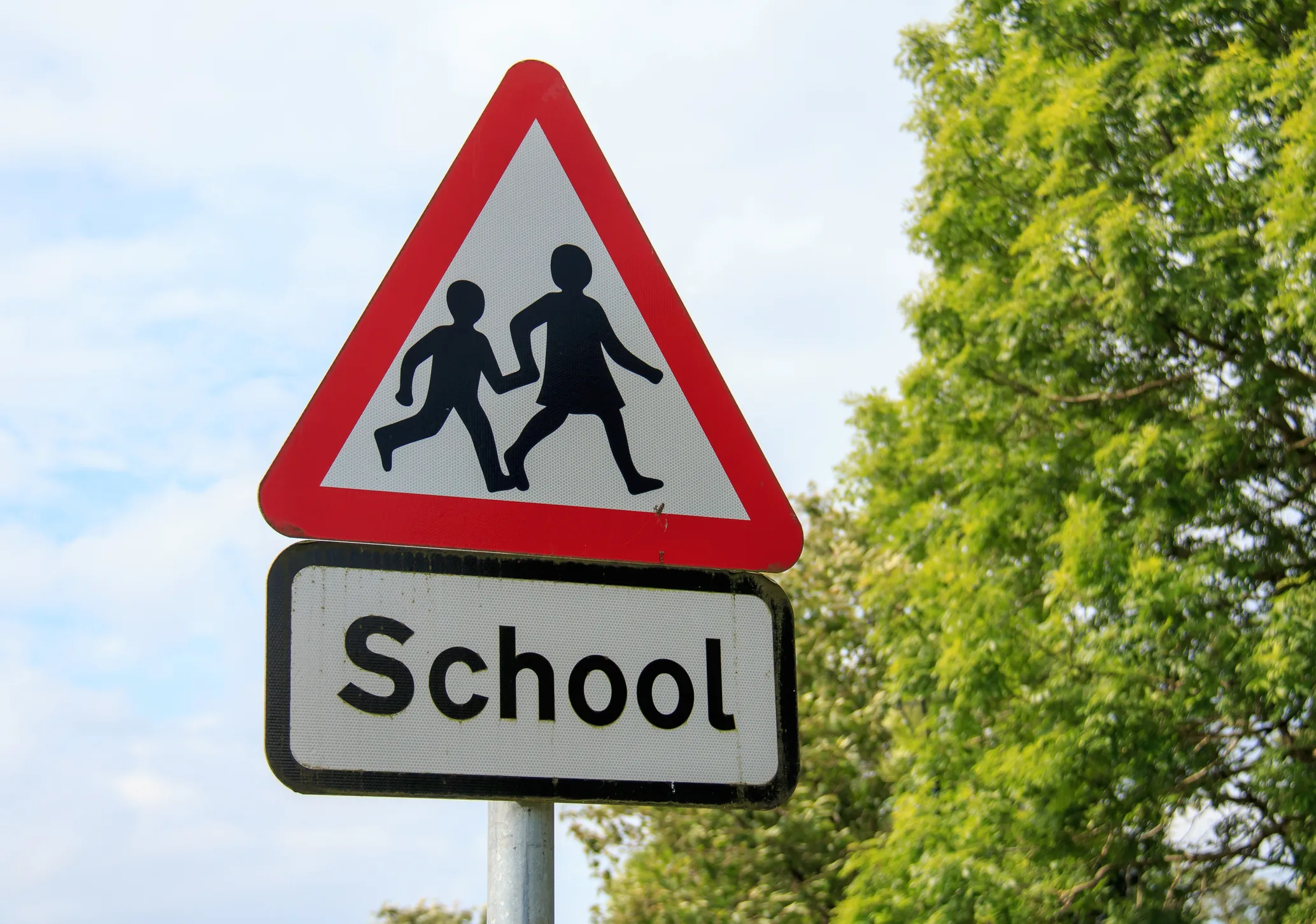
Earlier today we asked whether the girl killed outside Highgate School was protected any less because her school charges fees, and found that in Haringey the answer was no: the council had given Highgate's junior school one of its first School Streets, and the senior site missed out because it sits on a main road. A reader put the obvious objection to us: Haringey may be fine, but look at Barnet, where private schools sit on 30mph roads with nothing outside the gate. So we looked, and then kept looking.1
How we counted
A School Street is the one intervention councils have rolled out at scale: a timed traffic ban outside the gate at drop-off and pick-up. Most boroughs publish a list of theirs. We took eight lists, matched every school on them against the borough's independent schools, and read whatever each council says about how a school gets chosen. This is a count of published schemes, not a survey of every crossing and speed hump, and where a council's website blocked us we say so below.8910
Barnet: few for anyone, none for private schools
Start with the borough our reader asked about. Barnet has School Streets at 9.7 per cent of its schools, 16 schemes in all, and sits 28th of 33 boroughs on the 2026 Healthy Streets Scorecard. Only 13.9 per cent of its roads have a 20mph limit, against effectively 100 per cent in Camden and 99 per cent in Haringey. The council has rejected a borough-wide limit in favour of a scheme, consulted on this summer, under which residents apply for a 20mph zone on their own street and officers assess it. The existing zones the council points to are around state primaries and Queen Elizabeth's Boys' School, and residents on Mays Lane and Queens Road told the Barnet Society this year that even those are routinely ignored, with one reminder sign and worn-out road paint.21415
The School Streets we could identify are Colindale, Friern Barnet with St John's, Holly Park, Childs Hill, Woodridge, Edgware, Chalgrove and Danegrove with East Barnet School. Every one is a state school. Barnet's own consultation pages describe the process: a school "has been identified as a school which would benefit from having a School Street". Identified by the council, that is. The borough has more than 30 independent schools, from Mill Hill and King Alfred to a large cluster of Jewish schools in Hendon and Golders Green, and we could find none of them in the programme. Barnet's website blocked our requests for its full list and its 20mph policy document, so the count of 16 comes from the scorecard and the names from the council's consultation pages and local press.13202
Wandsworth: the clearest case
Barnet at least has few School Streets for anyone. Wandsworth does not have that excuse. Its published list runs to 29 schemes serving 31 schools, and the borough contains 22 independent schools, among them Thomas's, Broomwood, Newton Prep, Hornsby House, Finton House, Emanuel, Putney High and Ibstock Place. Not one of the 31 schools on the list is fee-paying. We read every name twice. The council's pages explain what a School Street is and how exemptions work, but not how schools are chosen, and the FAQ page the site links to no longer exists.819
Richmond, another borough thick with prep schools, has 21 operational locations serving 30 institutions plus two on trial. One of the trial schools, Broomfield House in Kew, is independent. The rest are state primaries, academies and church schools. Richmond's process is application-led, with the request having to come from the head teacher, so the absence may reflect who has asked as much as who has been refused.9
Where private schools do get them
Now the other side of the ledger. Kensington and Chelsea lists 13 School Streets and four of them serve fee-paying schools: Hill House, Knightsbridge School, Pembridge Hall with Wetherby, and Thomas's Kensington. Its page states the rule plainly: "Only schools that have requested assistance implementing a School Street will be considered." Camden's list includes South Hampstead High, North Bridge House, Southbank International and the Collège Français Bilingue. Ealing's page names Orchard House and Notting Hill and Ealing High, and even adjusts their operating dates to the schools' own term times. Haringey, as we reported this morning, gave Highgate Junior School one of its first.1011121
Borough | School Streets | Private schools among them | How schools are chosen |
|---|---|---|---|
Barnet | 16 (9.7% of schools) | None found | Council identifies schools |
Wandsworth | 29 schemes, 31 schools | 0 of 31 (22 independents in borough) | Not stated |
Richmond | 21 locations, 30 institutions, 2 on trial | 1 (Broomfield House, trial) | Head teacher applies |
Haringey | 44.1% of schools | 1 (Highgate Junior) | Council scores all schools on air quality, safety and road type |
Camden | 41 (49.4% of schools) | At least 4 | Not stated on the list page |
Kensington and Chelsea | 13 | 4 of 13 | Only schools that request one |
Ealing | Not fully listed | At least 2 | Not stated |
Bromley / Harrow / Bexley | 3 / 3 / 0 | Too few to judge | — |
Sources for each row are the councils' own lists and the 2026 Healthy Streets Scorecard; school type is our classification by name.367
Why the difference
Three explanations fit the pattern, and they are not mutually exclusive. The first is selection. Where the council draws up the list, as Barnet does and Haringey did, officers start from the schools they already deal with: the maintained primaries whose travel plans, air quality scores and complaints sit in council files. Haringey's scoring happened to sweep in Highgate Junior. Barnet's did not sweep in anyone private. Where the school has to ask, as in Kensington, Richmond and Camden, the private schools that ask get treated like everyone else.1013
The second is the road. Every borough's criteria exclude main roads and bus routes, and Havering's, which are unusually explicit, bar any school whose entrance is on or at a junction with an A or B road. Independent schools tend to occupy older, larger sites on the roads that were main roads before the suburbs grew around them. That will remove some of them from any list before a decision is made.17
The third is demand. A Transport for London study of schoolchildren's road safety cited research in Camden and Islington finding that attendance at an independent school was one of the strongest predictors of a child being driven to school, and so of lower exposure to injury as a pedestrian. Fewer walkers means less pressure from parents for a scheme whose point is to make walking safer, and a School Street also bars the very cars those parents arrive in. Some private schools will not have wanted one.18
The one place the rule is written down
School Streets are new. The older protection at the school gate is the crossing patrol, and there the distinction between state and private is sometimes explicit. Surrey County Council's road safety page says it intends "to fund all approved School Crossing Patrol sites at maintained schools and Academy and Free schools", subject to funding. Independent schools are not in that sentence. Councils are not obliged to provide patrols at all, and several allow a school to pay for one itself if a site does not qualify. We found no London borough stating in writing that independent schools are excluded from School Streets. We found two whose lists suggest they might as well be.16
What this does and does not show
It does not show that a private school pupil is more likely to be hurt. TfL's own research suggests the opposite, because so many are driven. It does not show that Barnet or Wandsworth has refused a private school that asked; neither council publishes refusals, and we did not ask them before publishing. It does show that in two large boroughs, the flagship school safety measure has gone to state schools only, that the boroughs with private schools in their schemes are the ones where schools apply rather than wait to be picked, and that in Barnet the bigger scandal is that almost nobody, state or private, has a 20mph limit that is enforced.
The fair question for Barnet and Wandsworth is therefore a narrow one: have any independent schools asked for a School Street, and if so, what happened? The fair question for every borough is the one Highgate raised this morning: what do you do for the schools, of any kind, that sit on the roads you cannot close?

1 comment
Sign in to join the conversation.
Live in Wandsworth with kids at a state primary that got a School Street two years ago and it has genuinely changed drop off. Never occurred to me that none of the private schools had one. The 'who gets to choose' point rings true, our head applied and pushed for it, and I suspect a lot of the fee paying schools just haven't bothered because parents drive in from further away anyway. Doesn't make it fair on the kids who walk though.