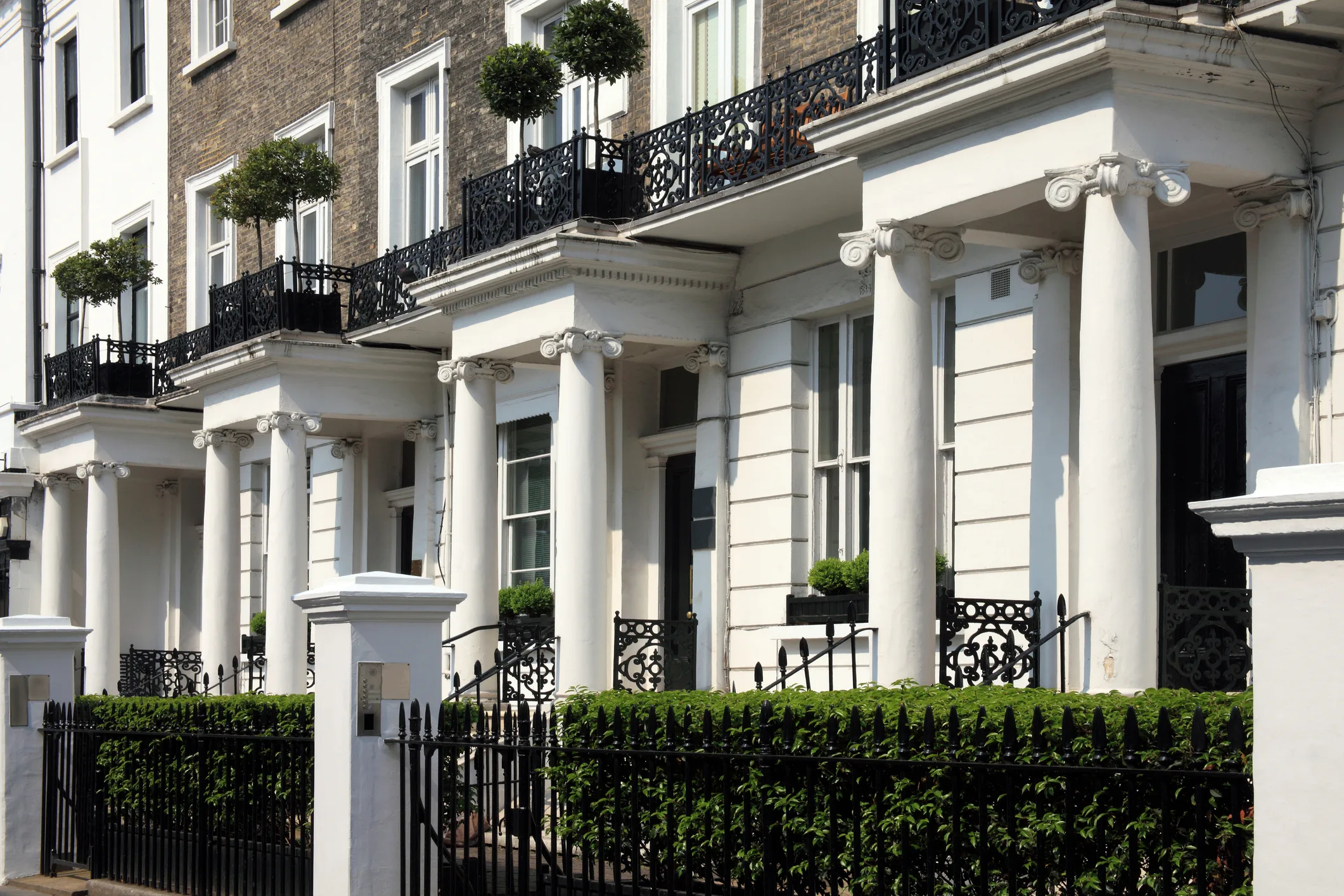
The question people ask about a new block in Nine Elms or a dark terrace in Belgravia is simple: who owns it? For forty years the honest answer was that nobody could tell you. The Land Registry would give you the name of a company in Tortola or St Helier, and the trail ended there. In 2022, after the invasion of Ukraine, Parliament passed an Act that was meant to make the company say who stood behind it. Two public datasets now exist: the Land Registry's monthly list of every title held by an overseas company, and Companies House's register of the people those companies have declared as their owners. We downloaded both at the start of October, with the register of UK-company titles, the complete record of every property sale since 1995 and the dwelling count for every council, and joined them. This is what they say, and what they still cannot.
Ninety-one thousand titles
The Land Registry's file, called OCOD, lists 91,109 registered titles whose legal owner is incorporated outside the United Kingdom. A title is not a home. It can be a flat, a house, a shop, a field, a car park, a substation or the airspace above a roof, and 758 of the titles carry a schedule of addresses, which usually means a whole block held on one number. The register records the address, the tenure, the company, its country of incorporation and the date it was added. It records a price only where the last sale appears in the Price Paid Data: 34,160 titles do, and they total £128.9bn, a figure dominated by office towers and hotels rather than homes. Private individuals with overseas addresses are excluded from the file for data-protection reasons; the Centre for Public Data obtained a count of them by freedom of information in 2021, 181,701 titles, about twice the company figure, and the Land Registry has never published an update.122627
To find the homes we read the address text of every title. Flat, apartment, maisonette, penthouse, studio or a floor reference made a flat; a house word, a plain numbered street address or a named property made a house; land, plot, car park, unit, shop, office, hotel, works and the like made something else, with street names such as Station Road masked first. That gave 21,948 flats, 28,577 houses and 39,826 other. Then we checked the reading against the only independent record of what a building is: the Price Paid Data, which classifies every sale since 1995 as flat, detached, semi-detached, terraced or other. One title in five has sold since 2015 and could be checked. The flat reading was right 93 times in 100. The house reading was right 43 times in 100; 47 times in 100 the sale record said "other", because a shop, a pub or an office on Oxford Street also has a street number. So the house count is an upper bound, and the honest figure is around 12,000 to 13,000 houses against about 22,000 flats. Both are small against the stock. England and Wales had 27.3 million dwellings at March 2025, so overseas companies hold something like one home in 800.43133
Where they are
Forty-three per cent of the titles are in Greater London, and more than half of the flats. Westminster alone has 9,652 titles and 4,641 flats, which is 35 flats for every 1,000 dwellings in the borough; Kensington and Chelsea has 4,951 titles and 2,409 flats, 27 per 1,000. Then the numbers fall away fast: Tower Hamlets and Camden have about eight per 1,000, Wandsworth six, Southwark six, Hammersmith and Fulham five. Outside London the pattern is new-build city centres. Salford has 717 overseas-company flats, more than any borough outside the inner west of London, and Manchester 572; Liverpool 429, Leeds 334, Luton 253, Nottingham 251, Birmingham 243, Brighton 227. In most of the country the count is in single or double figures.32
The same postcodes carry the council-tax second homes. Westminster recorded 10,889 dwellings as second homes in the 2025 tax base, Kensington and Chelsea 7,898 and Tower Hamlets 7,567, against a few hundred in most outer boroughs. Those are different lists, one of owners who are companies and one of homes that are nobody's main residence, and a home can be on both, one or neither. But they describe the same two or three square miles.34
Where the companies live
The country of incorporation is the one fact the Land Registry has recorded reliably since 1999. Jersey leads with 24,077 titles, the British Virgin Islands have 18,795, Guernsey 12,204 and the Isle of Man 9,825: four islands, 71% of the file. Singapore, Gibraltar, Luxembourg, Hong Kong, Ireland and the Cayman Islands follow with between 1,300 and 2,100 each. Luxembourg's 1,733 titles carry £11.8bn of recorded prices, which tells you they are not flats. For homes the order changes. The Virgin Islands hold 7,403 of the flats, two and a half times Jersey's 2,925, with the Isle of Man and Guernsey at about 2,160 each, then Hong Kong with 812, Ireland 515, Cyprus 458, Panama 404, Singapore 359 and Gibraltar 352. Jersey and Guernsey are where institutions put property funds; the Virgin Islands are where individuals put a flat.2
None of that says who owns anything. A Jersey company is a wrapper, and until 2022 nothing in British law required the wrapper to be opened. Private Eye mapped the previous decade of this in 2015, from a freedom-of-information release: £170bn of property acquired by offshore companies between 2005 and 2014, led by 22,155 purchases through the Virgin Islands and 20,590 through Jersey. The order has reversed since, and the Virgin Islands' 2026 share of the file is a little lower than its share of purchases then, but the two lists are otherwise the same lists.28
When they came
The register records the date the current owner was added, so the file is a picture of who holds what now, by when they bought it, not a count of purchases in each year; anything sold on since has dropped out. On that measure the overseas-company homes still held were bought in a rising wave through the 2010s: 1,275 flats and houses added in 2005, 2,552 in 2014, 3,953 in 2017, the peak. The non-resident stamp duty surcharge came in 2021 and the Register of Overseas Entities in 2022. The additions for 2022, 2023, 2024 and 2025 are 1,933, 1,864, 1,928 and 2,005. The level halved from the peak, but it halved in 2020, before either measure, and has been flat since. Companies House's own count tells the same story from the other side: 1,090 new overseas entities registered in the year to March 2026, down from 1,318 the year before, 322 of them from Jersey.14
The register that was meant to name them
The Economic Crime (Transparency and Enforcement) Act 2022 received Royal Assent on 15 March 2022, three weeks after the invasion of Ukraine, and the register opened on 1 August. Any overseas entity that owned land in England and Wales bought since 1 January 1999 had until 31 January 2023 to register and to state its "registrable beneficial owners": anyone holding more than 25% of its shares or votes, or the right to appoint its board, or "significant influence or control". An entity that says it cannot identify such a person gives the names of its managing officers instead. The Land Registry then placed a restriction on every such title: no sale, long lease or mortgage can be registered unless the entity is on the register and up to date. That restriction, not the fine, is the real teeth of the Act.567
The first independent audit, by economists at Warwick and the LSE with the Centre for Public Data in September 2023, found the register leaking at the design stage. Of 152,000 properties held through overseas companies, 109,000, over 70%, still had no public information about who really owned them. For 54,000 even law enforcement could not find out. In 87% of the hidden cases the cause was "choices by government to keep the information out of scope of the legislation, rather than rule-breaking", and the largest single cause was trusts, which accounted for 69,000 of the 108,000 hidden properties. The paper recommended that Companies House publish the title numbers each entity holds, so the two registers could be joined, and publish what it holds about trusts.2425
Three years on, we repeated the join with this month's files. Companies House has still not published the title numbers, and the Land Registry's company-number field contains no overseas-entity numbers at all, so the match has to be made on names. Normalising both, 73,698 titles, 81%, belong to a company that is on the register under the same name. The other 17,411 do not, and 16,899 of those were added since 1999 and so should be. Some are spelling variants or renamed companies; the largest unmatched name, a Singapore company called Profitable Plots with 1,335 titles, holds plots of land rather than homes. The government's own figure for entities that own property and have not registered is 933.411744
Then we looked at what the registered entities declared. Companies House publishes beneficial owners in its daily persons-with-significant-control file, and 66,657 titles, 73%, belong to an entity with at least one current beneficial-owner record. But a beneficial owner need not be a person. For 29,185 of those titles every declared owner is another company, a "legal person" or a protected record whose details are withheld. Subtract them and the titles for which a named human being is public are 37,472, 41% of the file. The remaining 59% end at a company, a trust, a protected entry, a managing officer or nothing.42
What the match found | Titles | Share |
|---|---|---|
Matched to a registered overseas entity by name | 73,698 | 81% |
Not matched to any registered entity | 17,411 | 19% |
Matched, with at least one beneficial-owner record | 66,657 | 73% |
Of which no owner is a named individual | 29,185 | 32% |
A named individual beneficial owner is public | 37,472 | 41% |
The names that are public answer the question people actually ask. Weighting each title equally among its declared individual owners, the largest nationality is British, 16,238 of 34,972, nearly half. Americans are next with 2,079, then Saudis 1,373, Irish 1,080, Chinese 879, Cypriots 793, Hong Kongers 781, South Africans 676, Indians 665, Kuwaitis 543, Canadians 533, Singaporeans 525, Israelis 523 and Emiratis 511. Where the declared owner is a company, it is in Jersey for 10,852 titles, the UK for about 7,000, Guernsey 2,926, the Isle of Man 2,120, Switzerland 1,140 and the United States 1,062. The overseas company that owns a London flat is, more often than any other single answer, a British person's way of owning a London flat.
The trust gap the 2023 paper identified has been narrowed on paper and not in public. The 2023 Act made trustees registrable and added a nominee rule, in force from March 2024. Regulations in February 2025 allow anyone to apply for the trust information Companies House holds, from 31 August 2025, for £55 an entity; the minister told the Commons that "the presumption is that trust data on the Register of Overseas Entities will normally be disclosed when requested", with a "legitimate interest" test only where a minor or several entities are involved. It is disclosure by application and by fee, not publication. The consultation on putting trust ownership of land on the public record closed on 21 February 2024 and the government's response is still, in September 2025's words, due "in due course". And asked in June how many entities had named another entity, a trust, or nobody as their owner, the department answered that "Companies House does not publish or verify figures" for any of the three.9101121223918
Four hundred and forty-five penalties
Failure to register is a criminal offence. In practice it is a civil penalty, set by Companies House at £10,000, £20,000 or £50,000 per property according to its council-tax band or value, with a parking space at £10,000 and each parcel of land at £20,000, secured where possible by a charge on the property itself. The first was issued on 28 July 2023. By 31 March 2026 penalties had been issued to 445 entities, all of them financial, none of them a prosecution. Of those, 245 worth £13.19m have been "reversed, waived or written off"; £9.87m remains valid; £1.18m has been paid.8121545
The 2024/25 annual report explains the gap. Serving notices abroad "can be a lengthy and complex process"; addresses were "inaccurate or insufficient"; some non-compliant entities "no longer existing". "We have therefore paused the issue of new financial penalties while we strengthen our enforcement strategy." No penalty was levied in 2024/25, and the accounts record a £1.5m underspend as a result. In 2025/26 the pause ended: one penalty was levied, 19 were reversed, and 119 failure-to-register debts worth £6.62m were written off as uncollectable. The report calls this "a short operational pause" followed by improved enforcement. In December 2025 the minister told the Commons the government "recognises the challenges of enforcing financial penalties on overseas entities" and would carry out a post-implementation review in 2027; in April 2026 the department said it "has not made a specific assessment" of the Act's effect on offshore-owned property.12132023
Register of Overseas Entities, enforcement to 31 March 2026 | Figure |
|---|---|
Entities on the register | 33,100 |
Entities known to own property and not registered | 933 |
Penalties issued since 2022 | 445 |
Penalties reversed, waived or written off | 245 (£13.19m) |
Penalties still valid | £9.87m |
Penalties paid | £1.18m |
New penalties levied in 2024/25 | 0 (paused) |
New penalties levied in 2025/26 | 1 |
Penalties ever issued for the quality of ownership declared | 0 |
And the second kind of failure has never been penalised at all. Asked how many entities had been found not to comply with the beneficial-ownership rules in 2025, the department said Companies House "did not identify any cases"; asked again for 2026, it said the law lets an entity give its managing officers instead and that "Companies House has not issued any penalties for beneficial ownership non-compliance since the Register of Overseas Entities commenced". Nobody has ever been fined for declaring that nobody owns them.1916
The freehold under the house
The overseas file is the small one. The Land Registry's companion file of UK companies and corporate bodies, CCOD, has 4,460,847 titles, and the same address reading gives 289,016 flats and 1,819,150 houses, 2.1 million addresses, or 7.7% of the housing stock. Here the house reading is more reliable, 73% confirmed against sales, because fewer of the numbered addresses are in commercial streets. The names at the top are not foreign investors. London and Quadrant holds 15,971 home addresses, Clarion 15,436, Guinness 9,837, Sanctuary 9,507, Bristol City Council 9,479, Notting Hill Genesis 8,974: housing associations and councils account for a quarter of the company-held homes. British Telecommunications appears with 11,840, which is exchanges with street numbers and a reminder of the method's limits.3
Above all of them sit two names most people have never heard of. Wallace Estates holds 22,092 titles, 21,634 of them freehold, 19,204 with a house address. Tapestart holds 20,023, 17,004 houses. Fairhold Huddersfield has 11,687, Shenstone Properties 8,013, Chime Properties 7,145. A company that owns 19,000 houses and is not a landlord is a ground-rent investor: it owns the freehold under houses that someone else owns on a long lease, and collects the rent and the fees. That is why the towns with the highest share of "company-owned" homes in the combined file are not in London. Fylde, on the Lancashire coast, comes out at 24%, Hyndburn at 17%, Burnley at 16%, because leasehold houses are a north-western habit. England has 4.90 million leasehold dwellings, 20% of the stock, 1.52 million of them houses; in London 39% of homes are leasehold and almost all of those are flats.35
The overseas file has the same business in a smaller form. Abacus Land 4, a Guernsey company, is first proprietor on 1,271 titles, 1,081 of them freehold and 481 with a house address; Adriatic Land 3, also Guernsey, on 880, 786 freehold; MRF Managing Trustee No 1 of Jersey on 613, 543 of them houses. Portfolios of that shape are freeholds under other people's houses, held through the Channel Islands, not oligarchs' mansions. The 2024 Leasehold and Freehold Reform Act abolished the two-year wait before a leaseholder can buy the freehold or extend, from January 2025, and a draft Commonhold and Leasehold Reform Bill published in January 2026 would ban leasehold on most new flats and cap ground rents at £250 a year; the housing minister has said the whole programme will take about five years. Until then the ground beneath a leasehold house is a tradeable asset, and the trade is visible in these two files.4740
What the state has decided
The government's policy on overseas ownership of homes is a surcharge and a register, and it says it wants nothing more. Non-UK residents have paid two percentage points more stamp duty on every band since 1 April 2021. In 2024/25 that surcharge was paid on 19,000 purchases in England and Northern Ireland, 2% of residential transactions, for homes worth £12.3bn; in London it was 5,600 purchases, 4% of all sales, worth £7.6bn, and the share rises steeply with price. Asked in February 2025 whether Britain would answer Spain's proposal to bar non-EU buyers in kind, the housing minister replied that "the government does not have plans to place specific restrictions" on overseas buyers and pointed to the 5% additional-dwelling surcharge, which applies to everyone's second home. The next lever, a High Value Council Tax Surcharge on homes worth £2m or more, is in the 2026 Finance Bill and is not aimed at foreigners either.36373846
Whether any of it matters for prices is a separate question, and the one academic study built on this exact dataset says it does. Using the overseas-company file by local authority, Filipa Sá found in 2016 that "foreign investment is found to have a positive effect on house price growth", an effect "stronger in local authorities where housing supply is less elastic"; it "is also found to reduce the rate of home ownership", with "no evidence of an effect on the housing stock or the share of vacant homes". The anti-corruption case is made in Parliament with a different number: in a Westminster Hall debate in November 2025 an MP cited Transparency International's estimate of "over £11 billion in suspicious wealth invested in British property, more than half of which was routed through shell companies in our overseas territories". That is an estimate of suspicious money, not a count of homes, and it is a small fraction of the £129bn of recorded prices in the file.2930
What this can and cannot tell you
It can tell you how many titles overseas companies hold, where, from which jurisdiction, since when, and whether the company has registered and named a human being. It cannot tell you who owns the flats behind the 59% that have not, because the law does not require it to be public, and Companies House declines to count them. It cannot separate a house from a shop with certainty, so the house numbers in this piece are ranges and the flat numbers are the ones to quote. It cannot see the 181,701 titles held by individuals living abroad, which the Land Registry withholds, nor the much larger number of homes bought by non-residents in their own names through a British address. It cannot say whether a given Jersey company is a pension fund, a family's holding vehicle or something worse; the register was supposed to, and for four titles in ten it now does. The full borough, country, year and owner tables, the written answers and the method are attached.43


Comments
Sign in to join the conversation.