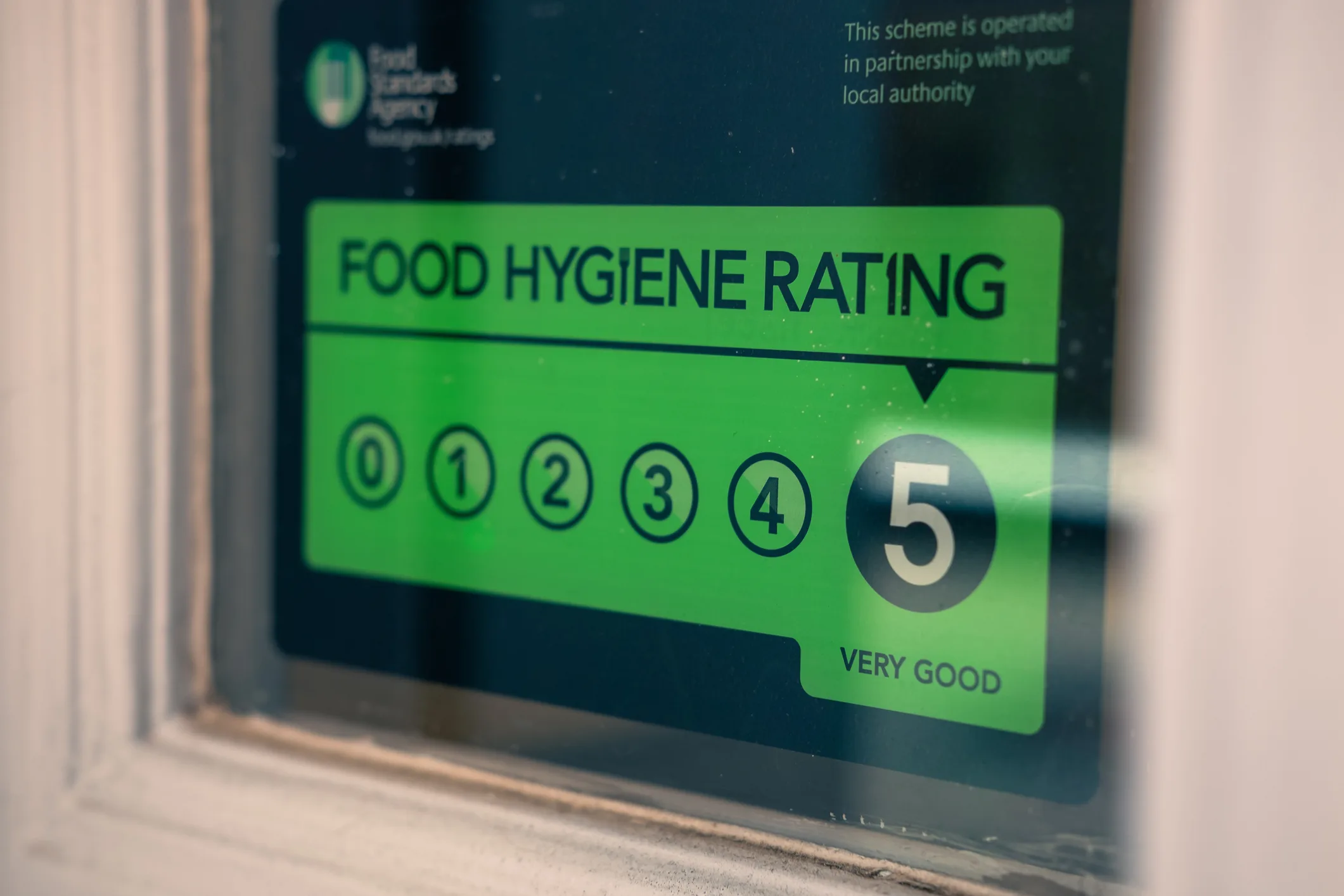
The green sticker in the window is the most successful piece of consumer information the British state has produced. Nine in ten adults know it, more than half checked one last year, and 28% walked away from a business that did not have one. Almost everyone believes it is compulsory. This piece is about the distance between what the sticker tells you and what it can know: how the number is made, how old it usually is, why a national chain almost never gets a bad one, what actually happens to the businesses that do, and why the food poisoning you got last month will almost certainly never appear in any of it.13
What the sticker actually says
A rating is produced by a council officer on one visit. The Brand Standard that governs the scheme scores three things: how hygienically food is handled, the physical condition of the premises, and "confidence in management", meaning the paperwork and the systems. Each is marked in bands and the three are added. A total of 15 or less, with no single area worse than 5, is a 5; a total over 50 is a 0. The Brand Standard says any business "should be able to achieve the top rating as it requires basic compliance with food hygiene law". The FSA's own consumer page describes the result as "a snapshot of the standards of food hygiene found at the time of inspection", and an appeal is defined as a claim that the rating does not reflect what was found "at the time of intervention". Nothing about the sticker says when that time was.37
We downloaded the whole register from the FSA's open data service on 29 September 2026: 613,167 premises across the UK, of which 554,312 are in the rated scheme covering England, Wales and Northern Ireland, and 58,855 in Scotland's separate pass-or-fail system, which we leave aside. Of the 486,981 with a numeric rating, 78.4% hold a 5 and 3.0%, 14,711 premises, are rated 0, 1 or 2: 917 zeros, 6,566 ones and 7,228 twos. The scheme has been getting rosier. In 2019, 69.8% of rated premises held a 5 and 4.9% were rated 0 to 2. The data is at least internally honest: for the 481,544 premises whose three sub-scores are published, the published rating matches the Brand Standard's arithmetic in every single case, and no 5 hides a poor hygiene score. A 1 is almost always a management failing: 96.7% of 1-rated premises carry the worst available mark for confidence in management.123
How old is the number on the door
The first thing the sticker does not tell you is its age. The median rating in the country was given 1.2 years ago, which sounds reasonable. The tail is not. A quarter of ratings are more than two years old, 13.8% more than three, and 34,044 premises are trading on an inspection more than five years ago; 8,359 are on one more than ten years old. The staleness is concentrated where you would least expect it. The low ratings are fresh, because the council goes back: 70% of 0 to 2 ratings were given in the last year and their median age is eight months. The 5s are the old ones, with a median of 1.3 years and 28% older than two. A 5 in the window is on average twice as old as a 1. Pubs, hotels, supermarkets and shops, which the risk model visits least, are the stalest categories: a third or more of their ratings are over two years old.1
That is within the rules. The Food Law Code of Practice sets inspection frequencies by risk: the highest-risk category at least every six months, the lowest at least every three years, and for the two lowest categories every other visit can be remote. A cafe rated five years ago is probably in a low category and legally overdue, or was rated, moved category and dropped down the queue. The second thing the sticker cannot tell you is that 43,380 premises, 7.8% of the register, have no rating at all because they are "awaiting inspection", mostly new businesses that have registered and not yet been visited. Add the 23,899 exempt premises and 12.1% of the register carries no score. The FSA told its board a year ago that 38,752 new businesses were awaiting a first inspection, down from 77,036 in 2021, and called it "a significant level of unknown public health risk". By October 2025 the figure was back over 39,500.41516
Authority | Rated premises | Rated 5 | Rated 0 to 2 | Awaiting inspection | Median age of rating | Ratings over 2 years old |
|---|---|---|---|---|---|---|
Liverpool | 3,419 | 66.0% | 7.8% | 25.8% | 3.2 years | 65.1% |
Birmingham | 7,934 | 65.6% | 9.8% (777) | 20.3% | 1.8 years | 45.6% |
Manchester | 5,240 | 71.4% | 5.0% | 19.2% | 1.6 years | 43.0% |
Leeds | 5,629 | 75.2% | 1.6% | 21.6% | 1.5 years | 39.4% |
Camden | 3,353 | 58.7% | 7.8% | 19.7% | 1.4 years | 37.4% |
Westminster | 5,303 | 70.5% | 6.4% | 2.7% | 1.3 years | 31.4% |
Newham | 2,428 | 49.0% | 14.0% | 5.9% | 1.0 years | 9.8% |
Ealing | 3,151 | 57.5% | 13.1% | 11.7% | 1.2 years | 22.3% |
Bristol | 3,737 | 76.4% | 1.7% | 12.9% | 1.2 years | 8.8% |
Nottingham | 2,666 | 89.6% | 1.8% | 8.4% | 1.0 years | 21.9% |
Stockton-on-Tees | 1,448 | 95.6% | 0.0% | |||
All England, Wales and NI | 486,981 | 78.4% | 3.0% | 7.8% | 1.2 years | 25.2% |
The council you live under matters more than the food. Newham rates 14% of its premises 0 to 2 and Stockton-on-Tees rates none of its 1,448. Liverpool's typical rating dates from 2023, 65% of its ratings are more than two years old and a quarter of its premises have never been rated. Birmingham has 777 premises rated 0 to 2, the most anywhere, and a fifth of its register unrated. The full table for all 331 authorities is attached. None of this can separate hygiene from enforcement. A borough with many 1s may have dirtier kitchens or officers more willing to write a 1; a borough with old ratings may have clean low-risk premises or no staff. The research that exists points to the second: a 2021 study found only 14% of English authorities up to date with their inspections, and a study published this year found that every £1 cut from per-head food safety spending was followed by a 2% fall in staffing and 1.6% fewer interventions per premises.1718
The chains
We asked which chains have a pattern of poor ratings, so we built a chain detector: 226 name rules over the register, checked by hand against the 120 most common names, accepting 61,643 premises into 190 chains with at least 30 rated outlets. The matching is imperfect and it undercounts, because councils register a franchise under whatever name the franchisee gave them and pubs under their own names, so a Wetherspoon is invisible and a McDonald's inside a service station may be registered as the service station. Against published estate sizes we found about 92% of McDonald's and 86% of Greggs before allowing for Scotland. The results are about the outlets we found, not the whole estate.141
The first answer is that the big brands are close to spotless. Of 1,205 Domino's rated, none is below 3. KFC, 910 outlets, none. McDonald's, two of 1,359. Greggs, one of 2,259. Costa, five of 2,400. Starbucks, one of 1,156. Nando's has 98.9% fives, Wagamama and Itsu 100%. Among the very large chains only Subway, with 19 low-rated outlets of 1,726, and Caffe Nero, with 12 of 577 and just 71% fives, stand out; Subway is entirely franchised, and Caffe Nero's spread of 4s suggests a chain marked down on paperwork rather than on the counter. Across the whole register the gap between chains and everyone else is stark: chain takeaways are rated 0 to 2 at 1.5% against 6.3% for independents, chain restaurants 0.6% against 3.9%, chain-owned convenience stores 0.7% against 10.2% for independent ones.
Chain | Outlets rated | Rated 5 | Rated 0 to 2 | Low-rated outlets | Median age of rating |
|---|---|---|---|---|---|
Costa | 2,400 | 91.8% | 0.2% | 5 | 1.1 years |
Greggs | 2,259 | 96.8% | 0.0% | 1 | 1.1 years |
Subway | 1,726 | 84.4% | 1.1% | 19 | 1.1 years |
McDonald's | 1,359 | 97.7% | 0.1% | 2 | 1.1 years |
Domino's | 1,205 | 99.0% | 0.0% | 0 | 1.0 years |
Starbucks | 1,156 | 96.8% | 0.1% | 1 | 1.2 years |
KFC | 910 | 93.4% | 0.0% | 0 | 1.1 years |
Caffe Nero | 577 | 70.9% | 2.1% | 12 | 1.1 years |
Burger King | 504 | 93.3% | 0.2% | 1 | |
Pret a Manger | 469 | 94.7% | 0.2% | 1 | |
Nando's | 456 | 98.9% | 0.2% | 1 | |
Papa John's | 392 | 87.2% | 1.0% | 4 | |
Pizza Hut | 355 | 83.4% | 0.8% | 3 |
The second answer is where the pattern really is. Rank the food-service chains by the share of outlets rated 0 to 2 and the top of the list is franchised fried chicken and pizza: Dixy Chicken, 25 of 130 rated outlets, or 19.2%; Perfect Fried Chicken 14.7%; Chicken Valley 11.1%; Pizza Time 9.8%; Morley's 12 of 138, or 8.7%; Caspian Pizza 8.3%. These are brands whose outlets are individually owned, often single-site, under a shared fascia, and the register treats them as what they are. The archived snapshots show they have improved and slipped back: Dixy was at 32% low-rated in 2019, fell to 12% by 2024 and is at 19% now; Perfect Fried Chicken went from 47% to 15%; Morley's from 27% to 9%; Chicken Cottage from 27% to under 2%, which shows it can be done. Every low-rated outlet of the sixty largest chains, with its address, council, rating and date, is in the attached appendix.12
The third answer is the one nobody advertises: the worst-rated "chains" in Britain are not restaurants but the convenience-store symbol groups, the independent shops trading under a wholesaler's fascia. Premier, owned by Booker, has 1,321 rated stores, only 53% of them at 5 and 117, or 8.9%, at 0 to 2. Best-one runs at 10.0%, Go Local 11.2%, Nisa 8.4%, Costcutter 7.7%, Londis 5.6%, Select and Save 16.4%. They have sat at those levels since 2019: Premier was 13% then and has not been below 8% in any snapshot. The comparison is with the supermarket-owned convenience formats on the same high streets, which are run as chains: Tesco Express 0.1% low-rated, Sainsbury's Local none, Co-op 0.3%, One Stop 1.2%. Same shelves, same postcodes, different management. The big supermarkets themselves are all under 1.5% low-rated, but their ratings are among the oldest in the register: half of Tesco's, Aldi's, Iceland's and B&M's are more than two years old, and the median Boots rating is nearly two and a half years old.12
Why the difference? Part of it is structure: a centrally managed chain has one food safety system, one training scheme and a head office that reads the register. Part of it is the regulatory architecture. Under the Primary Authority scheme a national business can partner with a single council which gives it "assured and tailored advice" that "other local regulators must respect", and can issue an inspection plan that shapes how every other council inspects its outlets. The FSA is trialling with large retailers a model in which inspection insight is shared through those plans rather than by visiting each shop. A Dixy franchisee has none of that. Nor does a Premier store, which is a symbol-group member buying stock, not a branch.1523
What happens to a 1
The honest answer is: not much, unless the council decides it. The rating is not an enforcement tool. The Brand Standard says its operation "does not affect the statutory duty of local authorities to monitor compliance with food hygiene law and to take enforcement action where appropriate", and a 0 or 1 carries no legal consequence of its own. What the business gets is a report, a rating letter within 14 days, and three routes to a better number. It can appeal within 21 days; in Wales, where the scheme is audited, 84% of appealed ratings were found correct. It can post a "right to reply" that appears beside the rating online. And it can ask for a re-visit. If the council does not charge, it must wait three months and be revisited within six. In England, where the scheme is not statutory and the council is "under no statutory duty to perform a re-inspection", councils may charge under the Localism Act, and where they do the standstill period disappears, the re-visit must happen within three months of payment, and "no limit applies" to how many times a business can pay. In Wales and Northern Ireland every council charges; Northern Ireland's fee is £150. The Welsh audit found re-visits "resulted in an improved rating in 94% of cases".356910
England | Wales | Northern Ireland | |
|---|---|---|---|
Scheme status | Voluntary, run under FSA brand standard | Statutory since 2013 | Statutory since 2016 |
Must the sticker be displayed? | No; "encouraged" | Yes, at or near each entrance; £200 fixed penalty, fine up to level 3 | Yes; £200 fixed penalty |
Re-visit on request | Free after 3-month standstill, or paid at council's discretion with no wait and no limit | Paid; council sets fee | Paid; £150 |
Appeal window | 21 days | 21 days | 21 days |
Rated 5 | 78.4% | 76.0% | 83.7% |
Rated 0 to 2 | 3.1% | 2.4% | 1.3% |
Awaiting inspection | 8.0% | 7.2% | 2.8% |
Enforcement proper is a different machine. An officer who finds an "imminent risk of injury to health" can serve a hygiene emergency prohibition notice that closes the premises on the spot, to be confirmed by a court within three days. Short of that come improvement notices and, if they are ignored, prosecution. The FSA's returns for 2024/25 count 6,199 formal hygiene enforcement actions across the three nations, up 30% on the year before the pandemic, against about 585,000 premises. The officers doing it number 1,497 full-time equivalents for hygiene, against 1,658 funded posts, a workforce the FSA describes as "substantially below levels seen more than a decade ago" with a "limited pipeline of people coming into the food safety profession". Its own summary of the state of local enforcement, to its board last September, was "system under significant strain".151619
When prosecutions come they are for what inspectors found, not for what customers suffered, and they take time. In June this year a South Norwood chicken shop that had ignored improvement notices and was found with mouse droppings on its counter shelves was fined £25,000 plus a £10,000 surcharge. A Coulsdon fruit and vegetable wholesaler with pigeon and rat droppings on and beside food, which had ignored multiple notices, was fined £100,000 and £7,097 in costs and surcharge; the judge said it was "highly likely" the conditions "would have resulted in customers experiencing ill health". Two Westminster restaurants closed by emergency notices for mice in early 2025 were sentenced in August 2026, seventeen months later, to a combined £37,282. These are the cases councils choose to publicise. The register shows that 463 of the 14,711 premises rated 0 to 2 have a new rating pending, which is the scheme's own measure of how many are on their way back up.202122
The sticker you do not have to show
Everything above assumes you can see the rating. In England you cannot count on it. Wales made display compulsory in 2013 and Northern Ireland in 2016, with fixed penalties for failing to put the sticker at the door; in England the FSA's annual report says businesses "are encouraged to do so". A 1-rated restaurant in Camden may keep the sticker in a drawer and break no law, and the only way to find out is to look it up. The FSA has wanted this changed for a decade; its 2022 strategy committed to "pressing the case for mandatory display both at premises and online", and in March this year its board heard stakeholders call on it "to do more to progress our long-standing ambition". On 16 September 2026 the board agreed to design a reformed system whose elements include "making it compulsory to display food hygiene ratings online across the UK, and in shops and restaurants in England". Developed proposals go to the board in March 2027 and a public consultation follows "later in 2027". No bill exists. The audit of the Welsh scheme shows what compulsion does: 219 fixed penalties in three years, "mainly targeted at 0 – 2 rated establishments", and 81% of those businesses displaying correctly afterwards.8910111242
The public is ahead of the law. The FSA's own survey, published today, finds 94% of people who know the scheme think display should be required by law, 55% checked a rating in the past year, and 28% decided against a business because it showed none. Online the gap is being filled by the platforms: under a charter with the FSA, Deliveroo and Uber Eats will not list a business rated below 2 and Just Eat below 3, and all three show the rating. A 1 can still be found on the high street; it is harder to find on an app.1314
When people get ill
The last thing the sticker cannot tell you is whether anyone has been poisoned there, and the reason is that almost nobody who is poisoned ever tells anyone who counts. The FSA's analysts estimate 2.4 million cases of foodborne illness a year in the UK, about one person in 28, and 180 deaths, most of them over 75, from norovirus, salmonella, listeria, Clostridium perfringens and campylobacter. The government's food security report puts the cost at £10.4 billion a year. Against that, the laboratory-confirmed reports that reach national surveillance in England in 2025 were 69,394 for campylobacter, 10,406 for salmonella, 2,457 for E. coli and 181 for listeria, of whom 28 died. The gap is measured. The national study of infectious intestinal disease found 147 community cases for every one reported: for campylobacter 9.3 to 1, for salmonella 4.7, for E. coli O157 7.4, for norovirus 288. And the reported numbers are rising: salmonella and campylobacter reports in England hit decade highs in 2024 and again in 2025, and as of last week a salmonella outbreak linked to imported eggs stood at 391 cases in England, 45 in hospital and one dead.24252728293031383926
Pathogen | Community cases per case reported to surveillance | Lab-confirmed reports, England, 2025 | Reports in 2019 |
|---|---|---|---|
Campylobacter | 9.3 | 69,394 | 56,441 |
Salmonella | 4.7 | 10,406 | 8,403 |
E. coli O157 | 7.4 | 568 (2,457 all STEC) | |
Norovirus | 288 | 13,430 (2025/26 season to June) | |
Listeria | 181 (28 deaths) |
Here is what happens when you report it. Food poisoning is a notifiable disease: a doctor who suspects it must notify the council's proper officer within three days, and a laboratory that confirms the organism must notify the UK Health Security Agency within seven. You, the customer, have no such route. Ring the council about the restaurant and you will be told what York's page says plainly: "If you think you may have food poisoning, you will need to get this confirmed through your GP before we are able to investigate", and "if you are not willing (or unable) to submit a sample we will not be able to take any further action, as we will have no evidence to proceed further". The page adds the line every environmental health officer knows and every customer forgets: "the last meal you ate may not be the cause of your symptoms." An outbreak, in the official definition, needs "at least 2 or more people" linked by time, place or exposure, and it is investigated by a team chaired by a health protection consultant, with the council doing the kitchen and the FSA the supply chain. In 2025 that machinery recorded 13 salmonella outbreaks in England with 269 cases, seven campylobacter outbreaks with 30, and four listeria outbreaks with 33. The sources of the salmonella outbreaks included four restaurants and a takeaway. None was named.323334353940
When the system does catch a restaurant, the Coventry case shows the whole arc. In June 2024 the council was told of an outbreak at Palm by H2O; 29 diners were infected with a strain of salmonella never before seen in the UK, and 17 of the 18 stool samples matched it. The business pleaded guilty in September 2025 to placing unsafe food on the market, failing to protect food from contamination and failing to train its handlers, and was sentenced in November: fines of £6,500 and £10,186, a £2,000 surcharge, seventeen months after the outbreak. In between, its rating had fallen from a 5 to a 1 and, on 19 August 2024, two months after the outbreak, it was awarded a 5 again after a paid re-score. The Brand Standard says an outbreak does not itself change a rating: the council's "primary focus should be on the outbreak", and a new rating "should be based on an inspection, partial inspection or audit". So the sticker in that window said 5 through the whole prosecution, correctly.337
The largest outbreak of recent years shows the other limit. In the summer of 2024, 293 people across the UK were infected with E. coli O145 from supermarket sandwiches; 129 went to hospital, eleven developed kidney failure and two died. The agencies traced it to three sandwich makers and four growers, identified a lettuce variety as the likely vehicle, tested it and found nothing. The final report, published in December 2025, concludes that the "food chain investigations were inconclusive and unable to identify the source of contamination and root cause of the incident". Nobody was rated, closed or prosecuted, because there was nobody to rate.36
What this cannot tell you
It cannot tell you whether a 5 is clean today; the FSA says the rating is a snapshot and our data says the snapshot is, on average, over a year old. It cannot separate a council that finds dirt from one that looks harder, or one with old ratings from one with no staff. It undercounts every chain, because names on the register are what councils typed, and it cannot see pub companies at all. It cannot say whether a low rating predicts illness, because no British study has tested that. It cannot tell you how many people a restaurant has poisoned, because for every case that reaches a laboratory between five and three hundred do not, and the ones that do are not linked to premises unless two of them arrive together with samples. And it cannot say when England will make the sticker compulsory, only that after a decade of asking, the regulator has now put a date on the plan and not on the law. What it can say is that the scheme's arithmetic is sound, its coverage has holes you can measure, its bad ratings cluster where ownership is thin, and its worst gap is not on the door but in the surveillance that never sees the customer who got sick.


Comments
Sign in to join the conversation.