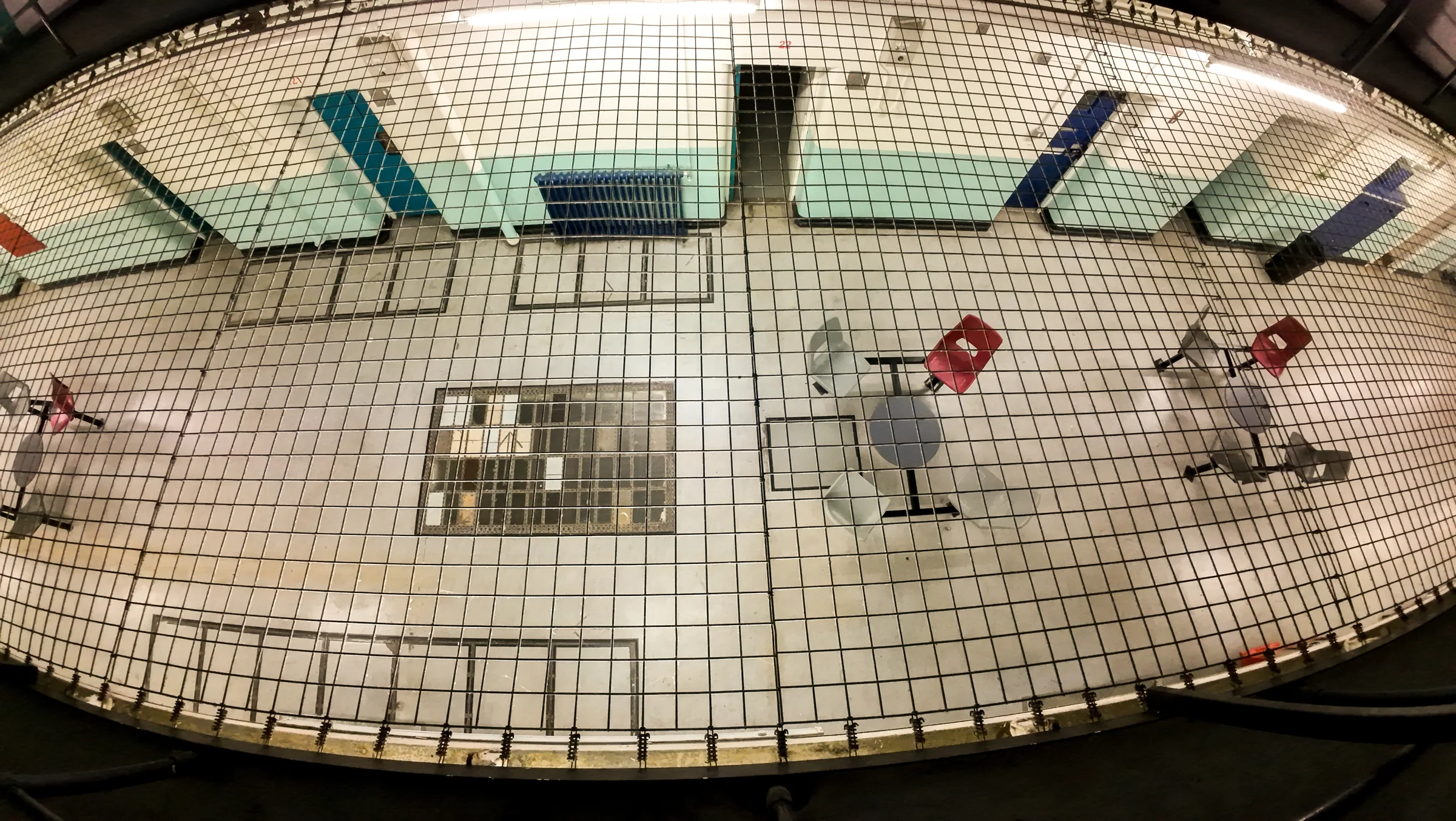
The Ministry of Justice publishes a number every Monday that almost nobody reads: how many people are in prison, and how many places there are. For most of the last four years the two have been within a thousand of each other. This piece is built from all 587 of those weekly bulletins since January 2015, the monthly figures for every prison, the ministry's own counts of who was released early and who was recalled, its projections and its building programme, and the record of what ministers said as the numbers closed in. The question is simple. How full are the prisons, what was done to keep them from overflowing, and did it work?
The line
Usable operational capacity is the number of prisoners the service says it can hold safely, after taking off an operating margin for cells that cannot be used because of category, sex or risk. In January 2015 it was 86,556. On 5 October 2026 it was 89,012, a rise of 2,456 places, or 2.8%, in almost twelve years. The population over the same period went from 83,287 to 86,779. The gap between the two lines is what the ministry calls headroom, and the chart shows how little of it there has been. In 2017 there were 18 weeks with fewer than 1,000 free places. In 2023 there were 20. The tightest week in the series is 13 October 2023, with 557 free places across the whole estate, 99.4% full; in the men's prisons alone the ministry's own figures show 244 free places on 16 October 2023, 269 that September, and 290 in May 2024. The record population, 88,521, came on 6 September 2024, four days before the first mass release.1
Capacity is not the same as space. The uncrowded standard is certified normal accommodation, and in August 2026 the service held 86,843 people in 81,616 in-use CNA places: 106% of what the buildings were designed for, with 8,542 people held above it. Sixty-one of 120 prisons were over their CNA. The worst were the local prisons that serve the courts: Leeds at 167%, Durham 166%, Wandsworth 164%, Preston 159%, Swansea 157%, Exeter 156%, Doncaster 152%. Wandsworth is the prison the inspectorate placed under an urgent notification in May 2024, when "eighty percent of prisoners shared cells designed for one person, and most men spent more than 22 hours a day confined". Dartmoor, 640 places, is closed because of radon.229
One bad day
The official account of how close it came is in the independent review the government commissioned from Dame Anne Owers, published in August 2025. By October 2023 the adult male estate had been "at or above 99% occupancy" for eight months. On 9 October "there were only 212 places remaining". On 12 October "it was assessed that the criminal justice system was within three days of meltdown". The Lord Chancellor, Alex Chalk, told the Commons on 16 October that the government would use a power in the 2003 Act to release some prisoners "up to 18 days before their automatic release date", as "a temporary operational measure to relieve immediate pressure contributed to by remand"; by then "there were only 183 spaces in the adult male estate". The 18 days became 35 in March 2024 and 70 in May. The review records that in May 2024, after the election was called, "an official-level COBR meeting was convened to discuss contingency plans in case the criminal justice system collapsed during the election campaign", including "invoking emergency powers under the Civil Contingencies Act 2004", and that "at one point there were fewer than 100 places in adult male prisons". Officials "kept an audit of all decision-making and documents, in case there was a public or parliamentary inquiry". The scheme's final tally was 13,325 people released early, half of them from sentences under twelve months, before it closed on 9 September 2024. Police cells were used too, at £688 a night against about £150 for a prison place, "a total bill so far of over £70 million".12136
The incoming government's first act on prisons was to say so in public. "Our prisons are on the point of collapse," Shabana Mahmood said on 12 July 2024, at HMP Five Wells: "if we fail to act now, we face the collapse of the criminal justice system. And a total breakdown of law and order." Six days later she told the Commons there were "around 700 spaces remaining in the male prison estate" and that "with 300 places left, we reach critical capacity". Her measure was to move the automatic release point for standard determinate sentences from 50% to 40%, excluding sexual, terrorist and serious violent offences and, unlike the previous scheme, domestic abuse. "This is an emergency measure, not a permanent change," she said, promising a review in 18 months. On 10 September 2024, 1,889 people were released on the first day; on 22 October, 1,223 more. Between the two, she told the House, "after the August bank holiday, we were left with fewer than 100 spaces in our men's prisons... We were, on many occasions, just one bad day from disaster." The weekly series shows the effect: the population fell 2,188 in the week of the first tranche and 1,598 in the week of the second.14151651
What the ministry's data then shows is that the 40% point did not stop being an emergency measure; it became the system. The transparency series counts every release whose date was brought forward by it: 12,437 in the last quarter of 2024, then between 10,000 and 11,600 every quarter since, 70,066 by March 2026, 43,610 of them in the latest twelve months, nearly half from sentences under twelve months. The headroom it bought was spent within months. By April 2025 there were 961 free places again. On 14 May 2025 the Lord Chancellor told Parliament that on central projections "the adult male estate will have capacity of just 200 prison places remaining by the end of September 2025 and will hit zero capacity, entirely run out of prison places, by November 2025", and announced the third measure: recalls to prison for sentences under four years would be fixed at 28 days.4117
Who came back
Recall is the part of early release that the headline numbers leave out. Everyone released from a determinate sentence is on licence until it ends, and can be returned to prison for breaching conditions. In 2015 there were 21,467 licence recalls; in 2025, 48,327. Recalls of people serving sentences under twelve months rose from 4,988 to 22,956. The recall population, the number in prison because they were sent back, was 6,176 in June 2015, 7.2% of all prisoners; it peaked at 13,829 on 31 July 2025, 15.7%, one prisoner in six. In the first three months of 2026 recall admissions were 32% higher than a year earlier, and the ministry's own commentary attributes the rise to the expansion of fixed-term recall, "the continued impact of early release schemes, such as SDS40, and the subsequent increase in the licence population". Of recalls in that quarter, 73% involved non-compliance with licence conditions and 22% a charge of further offending.3
The response to a recall population that had doubled was to make recalls shorter. From 2 September 2025 most people on sentences under four years could be held for only 28 days; the Sentencing Act replaced that with a 56-day fixed recall for most standard sentences from 31 March 2026. The recall population fell to 11,468 by December 2025 and was 12,145, 14.1%, in June 2026. The projections assume it rises again, to 15,100 by 2029. What nobody can say is how many of the people released early went on to offend. Asked in June 2026 for reoffending rates among those released under the 40% scheme, the ministry replied that the information "cannot be provided because it would form a subset of the data that underpins future versions of these Official Statistics". Asked how many had been recalled, it pointed to the aggregate tables. What is published is that 3,137 recalled offenders had not been returned to custody at the end of June 2026, 489 of them originally jailed for violence and 87 for sexual offences.172237
The building programme
The promise was made in October 2021: 20,000 new prison places by the mid-2020s, for £5.2bn. The National Audit Office's December 2024 report found 6,518 delivered by September 2024, 278 of them by crowding four private prisons harder, at a cost now put at £9.4bn to £10.1bn, "at least £4.2 billion more than planned", with the full 20,000 not expected until 2031 and a 12,400-place shortfall projected by the end of 2027. The new government restated the target as 14,000 places by 2031, the balance of the same programme, and said the previous fourteen years had added a net 500 places: the ministry's own note computes 482, from 13,009 built and 12,514 closed, and the sentencing minister told the Commons in July 2026 that 23 prisons were closed in those fourteen years. Since July 2024 it counts about 3,300 places delivered, 1,500 of them HMP Millsike, which was 80% in use this September. The net figure is smaller. Asked on 1 September 2026 how many places had been added to the men's estate since the election, the Lord Chancellor, Alex Norris, said 374. That is because the estate keeps losing cells: 3,364 places were out of use for maintenance on 31 August 2026, "all non-essential maintenance has been stopped to ensure that all cells that can be used are used", the maintenance backlog had doubled to £1.8bn by 2024, a quarter of places did not meet fire safety standards, and the collapse of the contractor ISG hit works on 3,700 places.1091144382439
Prison places, England and Wales | Figure | Source |
|---|---|---|
Promised, October 2021 | 20,000 by the mid-2020s | NAO |
Delivered by September 2024 | 6,518 (278 by crowding) | NAO |
Programme cost | £5.2bn planned; £9.4bn to £10.1bn now | NAO, MoJ strategy |
Net change in capacity, 2010 to 2024 | +482 | MoJ note |
Delivered since July 2024 (gross) | c.3,300 | MoJ, written answer |
Net gain in men's estate since July 2024 | 374 | Lord Chancellor, Hansard |
Out of use for maintenance, August 2026 | 3,364 | MoJ, written answer |
Target now | 14,000 by 2031 | MoJ strategy |
The sums
The ministry's December 2025 projections, which exclude the Sentencing Act, put the population at 91,400 by September 2026, 97,400 by 2028 and 99,600 by 2029, with a range of 97,400 to 102,100; the previous edition, a year earlier, had been 2 to 3% higher, before remand fell. Its January 2026 annual statement then lays the supply of places over those lines. Without the Act, demand passes supply in June 2026 and reaches 103,900 by 2032. With it, central demand stays below supply: 87,900 against 89,300 in November 2026, 95,900 against 98,900 in 2032. Two things in the table are worth more attention than the reassurance. The supply line falls to 88,300 through 2027, because of maintenance and the ISG collapse, before new houseblocks and the next new prison, Welland Oaks in 2029, arrive. And the high-demand case reaches 100,000 by 2032, above supply. The margin for the plan is the Act.7458
Adult estate, November | 2026 | 2027 | 2028 | 2029 | 2032 |
|---|---|---|---|---|---|
Supply of places | 89,300 | 88,300 | 90,900 | 95,100 | 98,900 |
Demand with the Sentencing Act (central) | 87,900 | 87,200 | 89,700 | 91,700 | 95,900 |
Demand without the Act (central) | 91,800 | 94,900 | 97,600 | 99,600 | 103,900 |
The new rule
The Act is the government's answer to the review it commissioned from David Gauke, which reported on 22 May 2025 and recommended an "earned progression" model: release at one-third of a standard sentence for those who engage with the regime, with the recall population, which had "more than doubled over the seven-year period from March 2018 to 2025", the central reason. The government accepted it the same day, with a harder edge: "the earliest possible release will be one third, with additional days added for bad behaviour... for those who behave excessively badly, I will not place an upper limit." The impact assessment of September 2025 estimates the measures will reduce demand by 7,500 places, a figure the annual statement dates to February 2028, and that without them demand would outstrip supply by 9,500 in early 2028. Royal Assent came on 22 January 2026. Then, in July 2026, the new Prime Minister paused the release provisions "within days of coming into office"; on 4 August rape, serious child sex offences and grooming were added to the exclusions, in September unlawful killing and indecent assault, and the start moved to 1 October. The commencement regulations phase it over ten tranches by sentence length, from sentences under 575 days on 1 October 2026 to the longest on 8 June 2027. The ministry's estimate of first-day releases is 4,500 across the ten, 700 on the first, against about 4,500 releases in a normal month, with 1,400 people made ineligible by the new exclusions. The week after the first tranche, headroom in the men's prisons rose by about 600.181920232421251
The ministers' language has moved with the numbers. In July 2024 the 40% point was "an emergency measure, not a permanent change". By October 2026 the Lord Chancellor was describing the progression model as the basis on which standard sentences would be governed for the foreseeable future, and the department's release of 1 October said "adult male prisons are now at 98% capacity after more than decade of underinvestment when just 500 net spaces were added". The Victims' Commissioner, Claire Waxman, said the same day that "the confidence being projected by government is not yet matched by the reality on the ground... This began as a prison capacity crisis. It risks becoming an issue of public safety." Her office had recorded, in September 2024, that 37 people jailed for breaching restraining orders had been released in error under the first tranche because of "incorrect logging". Releases in error rose with the crisis: 860 in the fourteen years to 2023/24, then 312 in 2024/25 alone and 192 in 2025/26, among them a sex offender released from Chelmsford in October 2025 who should have been deported, which produced an independent review, 33 recommendations and £82m for a system in which, the Lord Chancellor told the Commons, "every prisoner's sentence is worked out on paper".14263433353637
What the places are for
Whether early release is dangerous depends on what prison was doing for the people inside it, and the ministry's reoffending statistics are not kind. Adults released from sentences under twelve months were proven to reoffend within a year at 65.6% in the 2023/24 cohorts, against 64.2% ten years earlier; the latest single quarter, people released between July and September 2024, is 68.2%, the highest in the series, and each reoffender now commits nine further offences on average, up from six. For sentences of twelve months or more the rate fell from 34.6% to 22.9%, though the ministry's adjusted rate, which allows for the changing mix of offenders, fell less. The 2026 Act's presumption against sentences of twelve months or less is built on exactly these numbers: the people the system can least afford to hold are the ones it holds worst.40
Inside, the inspectorate's reports describe the conditions a 98% system produces. Its 2024/25 annual report called the supply and use of drugs "the overriding themes", with random tests positive in more than 30% of cases in several prisons and 59% in one; 28 of 38 prisons inspected were poor or not sufficiently good on purposeful activity. The 2025/26 report, the Chief Inspector's last, found "most prisoners spent long hours, sometimes more than 22 a day, locked in their cells with nothing to do" and 41% of men reporting drugs easy to get. Eleven establishments have been placed under an urgent notification since November 2022, five of them in twelve months in 2023, "the largest number... since the Urgent Notification protocol was introduced in 2017". Assaults per 1,000 prisoners rose from 240 in 2015 to 360 in 2025; assaults on staff doubled; self-harm incidents went from 34,665 to 70,632 a year. Self-inflicted deaths fell, from 90 to 79, and the ombudsman still recorded a prisoner taking their own life "approximately every five days". The probation service that receives everyone released was at 78% of its target for qualified officers in September 2025 with a projected gap of 3,150 posts; the NAO found officers in some regions working above 100% capacity and the department unable to say what effect its "Reset" of supervision had had.28272941303132
Scotland ran the same experiment with fewer people and the same result. It released around 500 prisoners early in summer 2024, moved its release point for short sentences from half to 40% in February 2025, ran a second emergency programme from November 2025 to April 2026, and cut the point to 30% in May 2026. Its population reached a record 8,603 on 26 May 2026.4243
What this can and cannot tell you
It can tell you, week by week, how close the system came to the line and when: 557 places in October 2023, under 100 in the men's prisons in the summer of 2024, 961 in April 2025, 1,556 at the end of September 2026. It can tell you who was let out and how many came back, that the capacity promised has been delivered at a sixth of its net headline, and that the plan now rests on a release model whose supply line dips before it rises. It cannot tell you whether any individual release was right, or how many of the 70,000 released at the 40% point went on to reoffend, because the ministry will not publish it. It cannot see inside the operating margin, which has grown from 1,340 to 1,640 and makes the headroom series slightly less comparable than it looks. And it cannot say what the new model will do, because the first tranche left prison a week ago. The full weekly series, every prison's crowding, the release and recall tables, the projections, the building programme and the inspectorate's notifications are attached.1


Comments
Sign in to join the conversation.